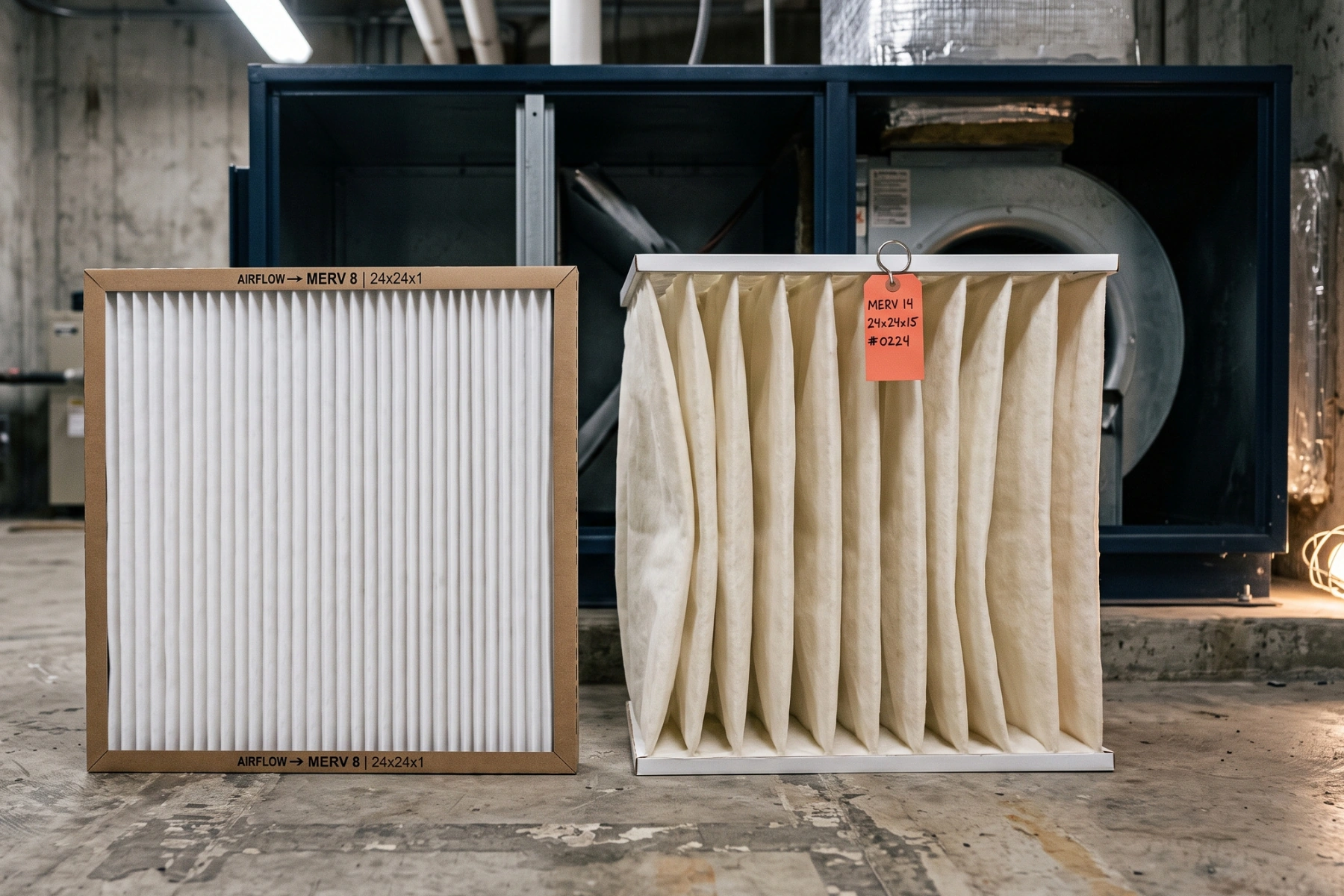
A pocket filter holds roughly ten times the media area of a flat panel that fits the same housing opening. That single fact explains everything else about it: lower resistance to airflow, far more dust held before it blocks, longer intervals between changes, and less energy burned by the fan pushing air through it.
Everything else in this article is a consequence of that one number. If you take nothing else away, take the number.
The whole trick is surface area
A flat panel filter gives you exactly as much media as the face of the opening it sits in. A 592 by 592mm panel offers roughly a third of a square metre of media, and not a square centimetre more. That is the geometry and there is no arguing with it.
A pocket filter takes the same opening and refuses to stay flat. The media extends backwards into the airstream in a row of long tapered pockets, which inflate under airflow. Unfold a typical eight pocket filter at 600mm deep and you are looking at several square metres of media occupying the same doorway.
The clearest way to picture it: a bedsheet held flat across a doorway, against the same bedsheet sewn into a row of windsocks. Identical doorway. Vastly more fabric in the way of the air.
What the extra area actually buys you
Lower pressure drop
The same volume of air spread across ten times the media means every square metre is working roughly a tenth as hard. Resistance to airflow falls accordingly, and it starts lower and stays lower for longer.
Much longer service life
Dust holding capacity scales with the media area. A filter reaches the end of its life when it hits its final resistance, and a filter with ten times the area takes a great deal more dust to get there. This is where most of the money is.
Less fan energy
The fan is working against resistance every hour the system runs. A bank sitting at low resistance costs less to push air through than a bank that spends most of its service interval loaded and struggling. Over a year of continuous operation across multiple air handling units, that difference stops being a rounding error.
Fewer changes, and fewer of everything that comes with a change
Every filter change is a labour hour. In some buildings it is also an access permit, a plant shutdown window, a disposal cost and a form. Halving the number of changes per year removes all of that, not just the filter cost.
Unit price is the only number where the flat panel wins. Every other number on the page belongs to the pocket.
How to choose one
Pocket count and depth
More pockets and greater depth both mean more media area, which means longer life and lower resistance. Common depths run from around 300mm through to 600mm and beyond. Deeper is generally better, right up until it does not fit, which brings us to the mistake everyone makes.
Clearance behind the frame
This is the single most common specification error with pocket filters, and it is a painful one because you usually discover it with the filter in your hands and the plant room door open.
A 600mm deep pocket filter needs 600mm of genuinely clear space behind the frame. Not 600mm to the next obstruction with a pipe running through the middle of it. The pockets also need room to inflate and separate under airflow, so pockets that are jammed against a coil or against each other lose most of the area you paid for.
Measure the plenum, not just the opening.
Grade
Pocket filters are made across the range, from coarse grades through to fine. On older documentation that means G4 through F9. On current data sheets it means ISO Coarse through ISO ePM1, since ISO 16890 replaced the older European standard in 2018.
Match the grade to the stage. A pocket filter is usually the secondary or final stage, sitting behind a coarse prefilter that catches the bulk material. Putting a fine grade pocket filter in the first position without a prefilter in front of it is an expensive way to catch leaves.
Rated airflow
Every filter has a rated air volume. Push more through it than it was designed for and resistance climbs steeply, efficiency can drop and the media itself can be damaged. Check the rating against the actual air volume of the unit rather than against the size of the opening.
Frame and housing type
Header frames, side withdrawal and front withdrawal all exist and they are not interchangeable. Confirm how the existing bank is accessed and held before ordering, particularly in a plant room where the access side was decided by whoever had the tighter budget.
The cost argument you will have to make
If you are proposing pocket filters to somebody holding a budget, they will look at the unit price and stop reading. The counter is straightforward, but it needs six numbers rather than one.
- Unit price of each option, which is the only number the panel wins
- Changes per year for each option, which is where the pocket starts pulling ahead
- Filter spend per year, being the first two multiplied together
- Labour per change, including access, isolation and disposal, not just the minutes at the housing
- Average resistance across the service interval, which drives the fan energy
- Cost per operating hour, which is the only number that actually answers the question
Gather those and the conversation changes from a price comparison to a running cost comparison, which is the comparison that was always true. It is also the comparison a facilities budget is actually assessed on, so you are not arguing against your finance team, you are handing them the right spreadsheet.
HVAC bag filters and paint pocket filters are not the same thing
Both get called pocket filters. They are built for entirely different jobs and ordering one when you need the other is a common and expensive mistake.
HVAC bag filters live in air handling units on supply or return air. They are graded on their efficiency against fine particulates, they protect people and equipment, and their performance is described in ISO ePM or MERV terms.
Paint pocket exhaust filters live in spray booth exhaust. They are built to hold paint overspray, which is a completely different loading behaviour to atmospheric dust. They are assessed on paint holding capacity rather than on particulate efficiency, and a booth exhaust filter and an air handling unit filter are not substitutes for each other in either direction.
If the enquiry mentions overspray, it is a booth filter. If it mentions supply air, occupancy or a coil, it is an HVAC filter.
Bag and pocket filter FAQs
What is the difference between a bag filter and a pocket filter?
Nothing. They are two names for the same product. Extended surface filter is a third name for it. The terms are used interchangeably across catalogues and specifications, which is unhelpful but harmless.
How many pockets do I need?
That comes from the air volume and the opening size rather than from preference. More pockets give more area and lower resistance for a given airflow. Send the housing dimensions and the design air volume and it can be sized properly.
Can a pocket filter replace my panel filter?
Only if the housing accepts it and there is depth behind the frame for the pockets to hang and inflate. The opening might match perfectly and the filter still be unusable because the plenum is 300mm deep. Measure behind the frame before ordering.
Do pocket filters need a prefilter in front of them?
In almost all cases, yes, and it is the cheapest decision in the system. A coarse prefilter costs a fraction of a fine grade pocket filter and dramatically extends its life by absorbing the bulk loading. Running fine filters without a prefilter is paying premium rates to catch cheap dirt.
How do I know when to change one?
Pressure differential across the bank is the reliable signal. Every filter has a recommended final resistance, and reaching it is what defines the end of life, not the calendar and not how grey it looks. A gauge across the bank pays for itself quickly.
Are pocket filters washable?
No. Extended surface pocket filters are disposable. Washing collapses the media structure and distorts the pockets, and a washed pocket filter does not recover its shape or its performance. Replace them.
How much space do I need behind the frame?
At minimum the full depth of the filter, plus clearance for the pockets to separate under airflow. If the space is genuinely tight, a shorter pocket filter or a rigid cell filter is the sensible alternative rather than forcing a deep filter into a shallow plenum.
Sizing a bag filter for your system
AeroFlow supplies extended surface bag and pocket filters across the common grades and depths, with sizing help if you would rather not work it out from a data sheet at 4pm on a Friday.
- The full extended surface bag filter range
- SpacePak bag filters
- SpacePeak bag filters
- SpaceCone bag filters
- PrecisionPak bag filters
Send the housing opening, the depth available behind the frame and the design air volume, and we will confirm what fits and what grade suits the position.