Measure the housing opening, not the old filter, and give your supplier three numbers in millimetres: length, width and depth. That one habit prevents most custom filter ordering mistakes, because the size printed on the filter in your hand is very often not the size that filter actually is.
Which sounds like a typo. It is not. It is an industry convention, and once you know about it, a lot of previously baffling filter problems suddenly make sense.
The 20 by 20 that is not 20 by 20
A panel filter sold as 20x20x1 inches typically measures somewhere around 19.5 by 19.5 by 0.75 inches when you put a tape on it. This is the difference between nominal size and actual size.
Nominal size describes the opening the filter is built to fit. Actual size is the filter itself, made deliberately smaller so a human being can get it in and out of a track without a mallet. There is nothing dishonest about it, and within one system it works fine.
It stops working the moment the label starts travelling. An American nominal size, a European actual size in millimetres and a tape measure in an Australian workshop are three different descriptions of the same hole, and nobody in the chain says which one they are using.
It is the only product category where 20 inches means 19 and a half and everyone has quietly agreed not to bring it up.
Why a loose filter is worse than you think
Air is lazy. It takes the path of least resistance, every single time, with no exceptions and no sense of obligation to your maintenance budget.
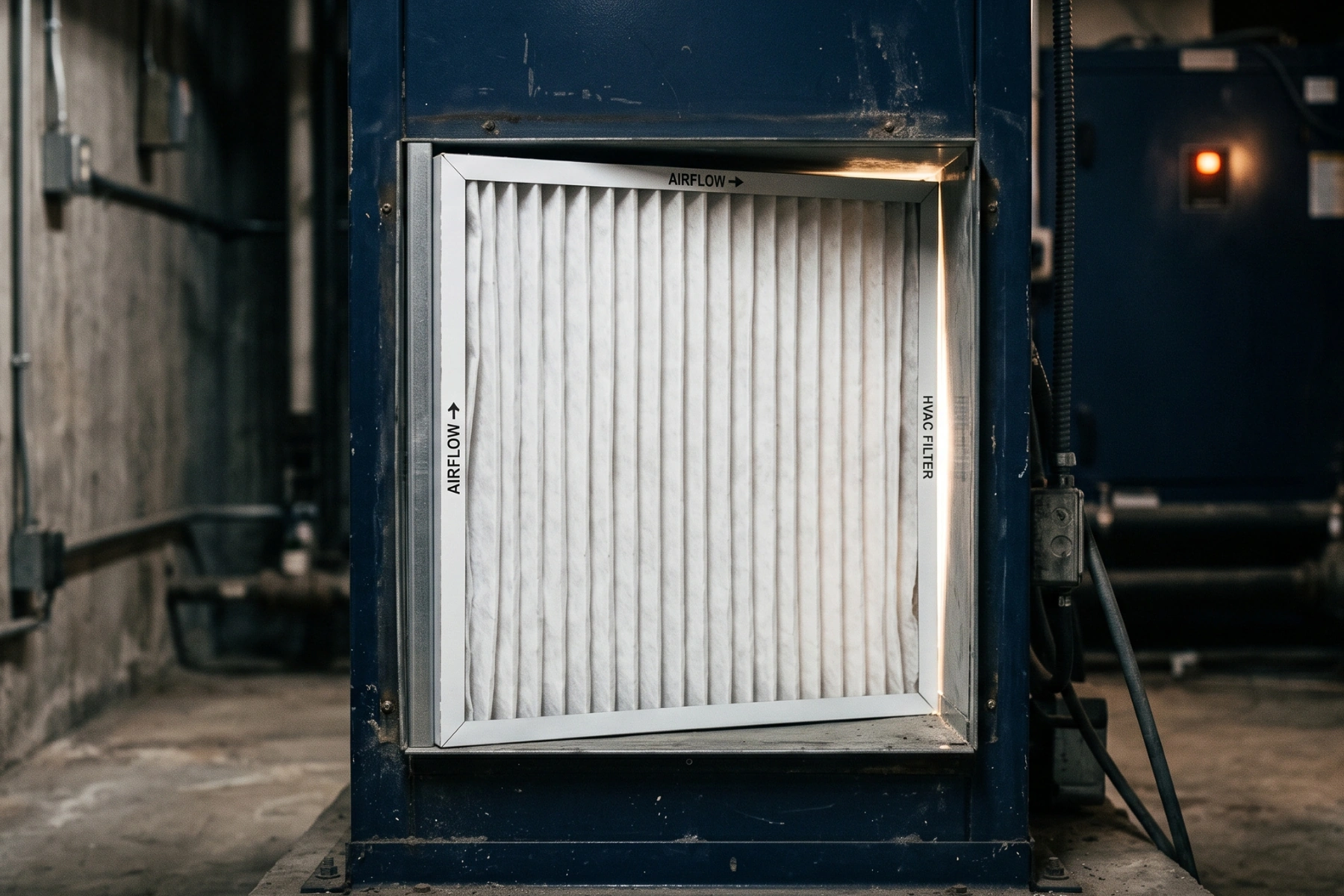
Put a filter in a housing with a 10mm gap around the frame and you have not built a wall with a small flaw in it. You have built a wall with an open door beside it. Media resists airflow. That gap does not. A meaningful share of the air simply goes around the filter, rejoins the airstream on the other side and carries with it everything the filter was installed to remove.
The result is that you paid for a high grade filter and received the performance of a much lower one. Sometimes considerably lower.
Here is the part that makes it genuinely nasty. Bypass air lowers the pressure drop across the bank. So the gauge looks healthy. The system reports that everything is fine, the filter looks reasonably clean because less air is actually going through it, and meanwhile the coil loads up, the finish quality drifts and nobody can work out why.
A bypassing filter does not fail loudly. It fails quietly, and it takes the evidence with it.
How to measure properly
Measure the opening, not the filter
The filter currently in the housing is evidence, not a specification. It may have been the wrong size for years. It may have been trimmed by someone in a hurry. It may have swelled with humidity or compressed under airflow. Measure the track, frame or housing opening itself.
Take all three dimensions
Length, width and depth. Depth is the one people leave off, and it is the one that determines whether the filter seats correctly or sits proud of the track with a gasket that never quite closes.
Work in millimetres
Inches invite fractions, fractions invite rounding, and rounding is how a 3mm error becomes a 12mm gap by the time it reaches production. Millimetres remove the temptation.
Say which number is which
Write it out in a fixed order and label it: length 592, width 287, depth 48. Suppliers see both conventions every week and they cannot read your mind about which dimension you consider the length. Two minutes of clarity here saves a fortnight of remaking.
Photograph it in place
A photo of the housing with the old filter still in it answers questions you did not know to ask: frame style, retaining clips, whether there is a header, whether a gasket is fitted, which way the airflow arrow points. It costs you five seconds and it routinely catches things a measurement cannot.
When there is genuinely no standard size
Custom sizing is not an exotic request. Whole categories of equipment have never taken an off the shelf panel.
- Older Australian HVAC plant, particularly anything installed before common metric panel sizes settled
- Imported air handling units built to a domestic size in their country of origin
- Purpose built enclosures and containment booths, which are sized around the equipment inside them rather than around available filters
- Retrofitted spray booths where the filter frames were adapted rather than replaced
- Equipment from manufacturers who no longer trade, where the original part number leads nowhere
- Anything that has been modified on site over twenty years by people who did an excellent job and left no drawings
In all of these, the correct answer is a filter made to the measurement. The incorrect and extremely common answer is to buy the nearest standard size and make it work.
Why cutting a panel down does not work
It is tempting. It is also the fastest route to the exact failure mode you are trying to avoid.
A framed panel filter gets its rigidity from the frame. Cut through it and the frame stops being a frame. The media edge, which was sealed into that frame, is now open, so particles travel along the cut face instead of through the media. Under airflow the panel flexes, and a flexing panel does not seal against the track.
If your housing needs a size nobody stocks, order that size, or use roll media that is designed to be cut and supported by a frame or grid. Those are the two right answers. A hacksaw is not the third.
What to send your supplier
- Three dimensions in millimetres, labelled: length, width, depth
- Frame type: cardboard, galvanised steel, aluminium or a media pad for an existing frame
- The media grade you need, and which standard your specification quotes it against
- Quantity, and roughly how often you expect to reorder
- Airflow direction, if the housing or old filter is marked
- A photo of the housing with the existing filter in place
That list takes about four minutes to put together and it is the difference between one quote and three rounds of clarifying emails.
Custom size air filter FAQs
Why is my filter smaller than the size printed on it?
Because the printed size is the nominal size, which describes the opening it fits rather than the filter itself. The filter is made slightly undersize so it can be installed and removed. A 20x20x1 panel is usually closer to 19.5 by 19.5 by 0.75 inches.
Should I measure the old filter or the housing?
The housing, every time. The old filter tells you what somebody ordered once. It does not tell you whether they got it right.
Can I just cut a filter down to fit?
Not a framed panel. Cutting destroys the frame rigidity and opens the sealed media edge, which creates a bypass path and lets the panel flex out of the track. Roll media is different: it is made to be cut, provided it is supported by a frame or retaining grid.
What if the opening is not perfectly square?
Common in older and modified plant. Measure at both ends and in the middle of each dimension, and send the smallest figure along with a note that it varies. A filter sized to the widest point will not go in.
How much clearance should a custom filter have?
Enough to install and remove it without forcing, and no more. Send the true opening measurement and let the supplier apply the tolerance, because they know what their frame and gasket need. Do not subtract a safety margin yourself, or the tolerance gets applied twice and you are back to a gap.
Are custom sized filters more expensive?
Per filter, usually a little. Against a bank of filters bypassing air for two years, a loaded coil and a rework bill, it is not a close contest. The real comparison is not custom against standard. It is custom against a standard filter that does not fit.
How long do custom sizes take?
That depends on grade, frame type and quantity, so ask when you send the measurements. Ordering from Australian stock avoids the multi week wait that comes with an overseas order, which matters a great deal when a unit is down.
Getting a filter that actually fits
AeroFlow Filters cuts filters to the measurement rather than to the nearest catalogue size, across panel filters, media pads and roll stock.
Send your three dimensions in millimetres, the frame type and a photo of the housing. We will confirm what fits, what grade suits the position and how quickly we can get it to you.