Which filter combination does your spray booth need?
It depends on your booth’s airflow design.
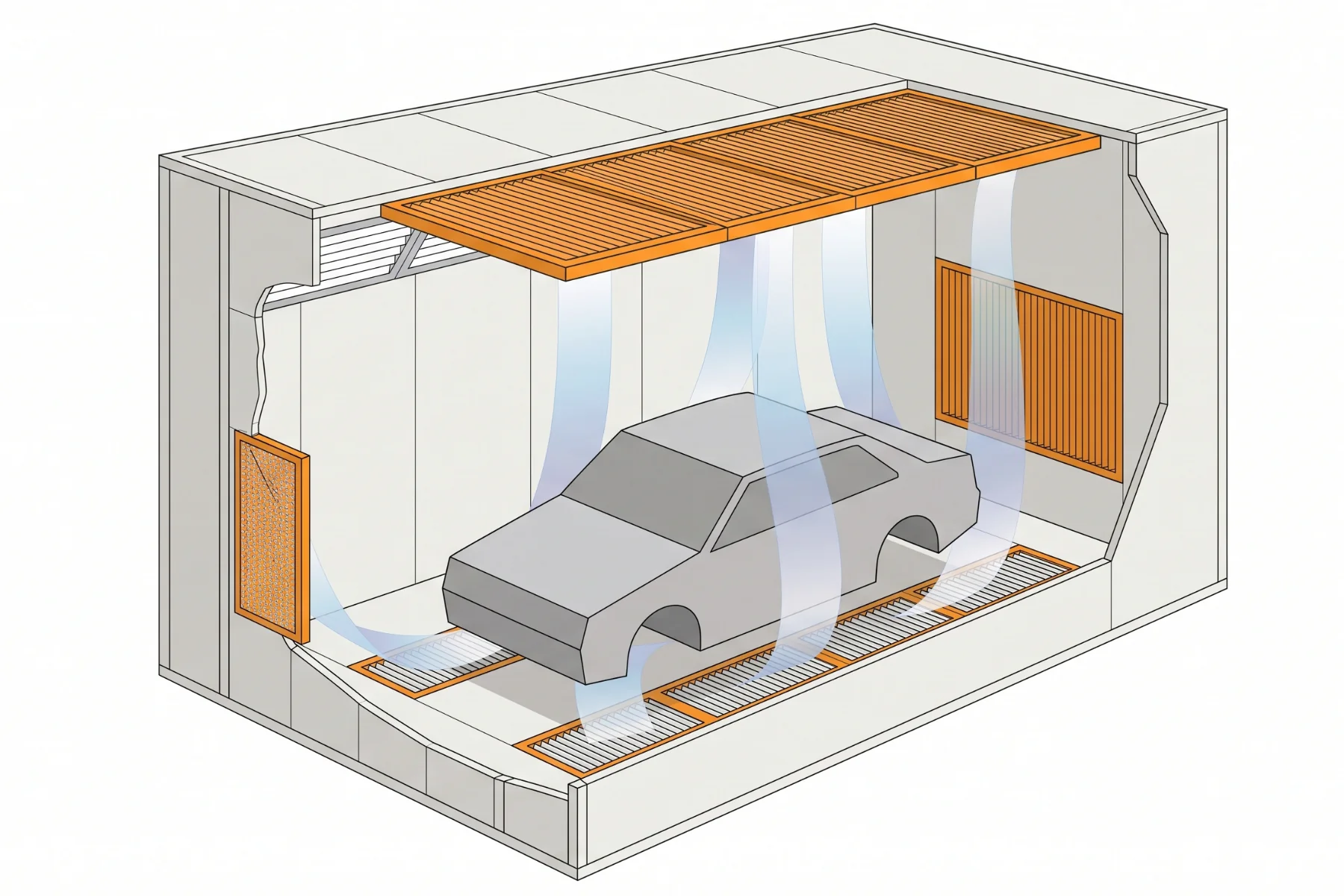
A crossdraft booth needs an intake or pre filter on the entry wall plus an exhaust filter on the opposite wall. A downdraft booth needs ceiling or plenum filters, floor filters in the extraction pit, and exhaust filters at the extraction point. A semi downdraft booth needs ceiling filters at the front, plus exhaust filters on the rear wall, and usually an intake pre filter on the air handling unit. Every position does a different job, so leaving one out creates a weak point that the other filters cannot compensate for.
You pull a panel out of the booth and there are nibs through the clear, dirt inclusion running the length of the guard. The job goes back for flatting and polishing, the customer gets a call, and the afternoon is gone.
Was it the prep? The gun? Or was it the ceiling media that nobody has touched in two years?
Most operators buy spray booth filters one position at a time. The exhaust wall starts to look saturated, so an exhaust filter gets ordered, and nothing else on the booth gets a thought until something visible fails. Buying by position rather than by system is the most common reason a booth underperforms despite the operator spending real money on filtration. This spray booth filter combination guide starts where the decision should start, which is with your booth’s airflow design.
Which Spray Booth Do You Have?
If you have recently taken over responsibility for a booth, settle this first. Airflow direction decides which filter positions physically exist, so every ordering decision follows from it. Three checks will tell you which one you are running.
Look at the floor. Grates or a pit running under the work area mean downdraft. A solid floor means crossdraft or semi downdraft.
Look at the ceiling. Filter media across the full roof area points to downdraft. Media across only the front section points to semi downdraft. No ceiling media at all points to crossdraft.
Look at where the air leaves. A full filter wall at the far end is crossdraft. Extraction at floor level beneath the vehicle is downdraft. A filter bank low on the rear wall is semi downdraft.
Crossdraft Spray Booth Filter Setup
A crossdraft booth moves air horizontally. Air is drawn in through filters at one end, usually in the doors or an intake wall, travels straight across the work piece, and exits through exhaust filters on the opposite wall. It is the simplest and cheapest configuration, which is why so many small and medium Australian workshops run one.
That simplicity puts a heavy load on two positions. The intake filter is the only barrier between workshop dust and the wet panel, and because air travels the full length of the vehicle before it leaves, anything that gets past it has maximum opportunity to land in the paint. The exhaust wall then handles the entire overspray load in a single stage, so it saturates faster than most operators expect.
A typical crossdraft spray booth filter setup pairs a synthetic panel pre filter or Andreae concertina media at the intake with fibreglass flat sheet media, Ecoguard media or Paint Pocket media on the exhaust wall. Choosing between the three comes down to overspray volume and how often you are willing to change filters.
Downdraft Spray Booth Filters
A downdraft booth draws air through the ceiling and drives it vertically down over the work piece into a floor pit for extraction. Contamination is carried away from the panel rather than across it, which makes it the cleanest configuration available. It also has the most filter positions, and therefore the most opportunities to leave a gap.
There are four. An intake pre filter protects the air handling unit. Ceiling or plenum media covers the full roof area. Floor filters sit in the extraction grates. Exhaust filters catch overspray before air is discharged.
Ceiling media is the position neglected most often, because it sits out of sight and fails quietly rather than visibly. When it loads up or tears, unfiltered workshop air drops straight onto the panel, and no amount of exhaust filtration will save the finish. It matters for compliance too, because the airflow performance assumed by AS/NZS 4114:2020 only holds when every stage is clear.
Floor filters carry a mechanical load that no other position does. They are walked on, trolleys roll over them, and they still have to hold their shape while absorbing overspray. Heavy duty fibreglass media is the usual specification here, and lighter media borrowed from another position tends to collapse and open bypass channels around the grate edges.
Semi Downdraft Booth Filter Positions
A semi downdraft booth sits between the two. Air enters through ceiling media at the front and is drawn diagonally down and back, exiting through exhaust filters on the rear wall. It installs for less than a full downdraft booth and controls overspray better than a crossdraft, which makes it a common step up for shops replacing an older booth.
The filter set reflects that hybrid: ceiling media at the front intake section, exhaust media on the rear wall, and in most installations a pre filter protecting the air handling unit. Most semi downdraft booths have no floor position, but check for grates before you order rather than assuming.
The known weakness is the dead spot along the floor at the front where airflow is slowest, so anything shedding into that zone lingers. Keep the ceiling media above it in good condition rather than nursing it along for an extra month. The diagonal path also loads the lower and rear exhaust panels faster than the rest of the bank, which matters when you plan replacements.
The Spray Booth Filter Combination Matrix
Use this as your ordering checklist. Confirm which positions your booth actually has, then match the media to each.
| Booth type | Intake or pre filter | Ceiling or plenum | Floor | Exhaust |
| Crossdraft | Synthetic panel or Andreae concertina | Not fitted | Not fitted | Fibreglass flat sheet, Ecoguard or Paint Pocket |
| Downdraft | Synthetic panel or Andreae concertina | Ceiling media across full roof area | Heavy duty fibreglass floor media | Fibreglass flat sheet, Ecoguard or Paint Pocket |
| Semi downdraft | Synthetic panel or Andreae concertina | Ceiling media at front intake section | Not usually fitted, check for grates | Fibreglass flat sheet, Ecoguard or Paint Pocket |
Why the Weakest Position Decides Your Finish
Filtration is a chain, and your finish is decided by the weakest link rather than the strongest. A premium exhaust filter cannot catch dust that entered through a torn ceiling panel, because by then the contamination is already on the paint. Perfect ceiling media cannot hold booth pressure if the exhaust wall is blocked and the fan is fighting resistance it was never sized for. Each position is cheap relative to the cost of stripping and respraying a bonnet.
The same logic applies to media choice. Paint arrestor media used at the intake clogs within days in a busy shop, and coarse intake media used on the exhaust wall lets fine overspray through to your fan and ducting.
Audit Your Booth Before You Order
Walk the booth before you call anyone. Five checks take about fifteen minutes and turn four separate orders into one.
- List every opening air passes through, including the ones easy to forget: door vents, secondary intakes and the air handling unit itself.
- Measure each opening, not the filter sitting in it. The filter in place may already be the wrong size.
- Note the format each position takes, whether individual panels, continuous roll cut to length, or media dropped into a grate.
- Read your pressure gauge. A manometer or magnehelic reading across the filter bank tells you the real condition of the media, which a date on a calendar cannot. A filter that lasts six weeks in a quiet month can need changing in three during a busy one.
- Check for bypass. With the booth running, look for light leaking around the filter frames. Unseated or bent frames let unfiltered air straight past the media.
One Supplier, One Set of Measurements
Ordering every position from one supplier at the same time means one delivery, one set of measurements on file, and one point of contact when something does not fit. It also removes the mismatch problem, where filters bought from three sources arrive in three different thicknesses and none of them seat properly in your frames.
AeroFlow Filters supply every position in this matrix, most of them custom cut to your dimensions rather than to a booth manufacturer’s standard sizes. That matters most for older booths, imported booths and booths retrofitted over the years, which describes a large share of the booths working in Australia today.
Frequently Asked Questions
What filter combination does a crossdraft spray booth need?
A crossdraft booth needs two filter stages. An intake or pre filter goes at the entry end, usually in the doors or an intake wall, using synthetic panel media or Andreae concertina media. An exhaust filter goes on the opposite wall using fibreglass flat sheet media, Ecoguard media or Paint Pocket media. Because a crossdraft booth handles the full overspray load in one exhaust stage, that position saturates faster than in a multi stage booth.
How do I tell whether my booth is crossdraft, downdraft or semi downdraft?
Check three things. Floor grates or a pit under the work area mean downdraft. Ceiling media across the full roof with no floor extraction, exiting low on the rear wall, means semi downdraft. No ceiling media at all, with a filter wall at each end of the booth, means crossdraft.
Do all spray booths need floor filters?
No. Floor filters are used in downdraft booths where air is extracted through grates in the booth floor. Crossdraft booths have no floor extraction, so there is no floor position to filter. Most semi downdraft booths have no floor filters either, because extraction happens at the rear wall rather than underfoot, though it is worth checking your own booth for grates.
Which filter position is most often neglected?
Ceiling and plenum media in downdraft and semi downdraft booths. It sits out of sight above the work area and fails quietly rather than visibly, so operators focus on the exhaust wall where saturation is obvious. When ceiling media loads up or tears, unfiltered workshop air falls directly onto the wet panel and causes contamination defects that get wrongly blamed on the exhaust system.
Can I use the same filter media in every position?
No, and doing so is a common and expensive mistake. Each position has a different job, so each needs different media properties. Floor filters need structural rigidity to survive foot traffic and equipment weight. Exhaust filters need high paint arrest efficiency and holding capacity. Intake and pre filters need coarse particle capture at low pressure drop, which is a simpler and cheaper specification than the exhaust position.
Can I use the same filter media in every position?
No, and doing so is a common and expensive mistake. Floor filters need structural rigidity to survive foot traffic and equipment weight. Exhaust filters need high paint arrestance and holding capacity. Intake and pre filters need coarse particle capture at low pressure drop, which is a simpler and cheaper specification than the exhaust position.