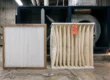
Ask most spray booth operators about filtration and the conversation goes straight to the exhaust wall. That is understandable, since exhaust filters do the visible work of capturing overspray. But the air entering your booth matters just as much as the air leaving it. The filter standing between the outside world and your spray zone is the inlet filter, also called the pre filter, and it is the most overlooked component in the entire system. This article explains what it does, why it deserves your attention, and how to keep it working for you.
Inlet Filter and Pre Filter: Two Names, One Job
First, the terminology. An inlet filter and a pre filter are the same thing. Both terms are used across the industry, sometimes interchangeably within the same workshop, so this article uses both. Whichever name you prefer, it refers to the filter installed at the air intake of the spray booth. Not all spray booths utilise prefilters but many do. They make a real difference.
An inlet or prefilter’s job is to capture dust, debris, insects, and coarse airborne particles before they enter the booth environment. Everything that gets past the inlet filter is inside your booth, circulating above wet paint. There is no second chance to catch it.
Why the Inlet Is Your First Line of Defence
Here is the argument that too few operators hear from their suppliers. Contamination entering through the inlet is just as damaging to paint finish quality as poor exhaust filtration. Dust nibs, specks, and inclusions in a fresh coat are among the most common causes of rework in refinishing, and a large share of that contamination rides in on the intake air. An operator who blames the exhaust system for finish defects while running a tired or poorly fitted pre filter is often fixing the wrong problem.
The inlet filter also protects the rest of your filtration system. Coarse particles that slip through the intake load up your ceiling or plenum filters prematurely, shortening their life and driving up replacement costs downstream. A healthy pre filter is cheap insurance for every filter behind it. It keeps the expensive media doing the fine work it was specified for, rather than clogging on dust it should never have seen.
Common Inlet Filter Types for Spray Booths
Three media types cover the vast majority of spray booth inlet applications. Fibreglass panel filters are the traditional workhorse, offering good coarse particle capture at low cost with progressive loading through the media depth. Synthetic panel filters use engineered polyester media for higher arrestance and more consistent performance, and many operators consider them a step up for a small premium. Concertina paper filters, best known under the Andreae brand, bring their pleated design to the inlet position, where their large surface area suits high dust load environments and extends replacement intervals.
There is no single correct choice, because the right media depends on your environment, your booth, and your maintenance rhythm. A booth beside a busy road or in a dusty industrial estate has very different intake demands from one inside a sealed workshop. What matters is matching the media to the conditions, which is exactly the conversation a knowledgeable supplier should be having with you.
The Trap of the Clean Looking Filter
One habit costs operators more than any other: judging an inlet filter by its appearance. Pre filters load from the inside of the media, not just the surface, so a filter can look reasonably clean while its airflow has already dropped well below spec. Reduced intake airflow changes booth pressure balance, slows drying, disturbs spray patterns, and can pull unfiltered air in through gaps and door seals. By the time a pre filter looks visibly dirty, it has usually been hurting your finish quality for weeks.
The fix is to change inlet filters on schedule or on measured pressure drop, not on appearance. If your booth has a manometer or pressure gauge across the intake, use it. If not, set a conservative replacement interval based on your environment and stick to it. Seasonal conditions matter here too, since pollen in spring, dust in dry summers, and nearby construction work can all shorten the realistic life of a pre filter well below its usual interval. Reviewing the schedule a few times a year keeps it honest.
The Fit Matters as Much as the Media
Inlet dimensions vary enormously between booth makes and models, far more than exhaust formats do. Intake plenums, door vents, and roof intakes all take different sizes, and many older or imported booths use openings that no standard filter matches. A filter that does not fill the opening properly lets unfiltered air stream around its edges, which can defeat the purpose of having a filter at all.
Measuring correctly is straightforward once you know to do it. Measure the opening itself rather than the old filter, record width, height, and depth, and repeat for every intake the booth has, since many booths draw air through more than one opening. Door vents and roof intakes are easy to miss, and an unfiltered secondary intake undoes the good work of a perfectly fitted main filter.
This is where AeroFlow Filters’ approach differs from off the shelf supply. AeroFlow Filters supplies custom sized inlet filters for all booth brands, cut to the exact dimensions of your intake openings regardless of who made the booth. Stock is held in Australia and shipped with fast dispatch, so a correctly sized pre filter is never the reason a booth sits idle. If you are unsure what your booth needs, the local AeroFlow Filters team can work it out with you directly.
The Takeaway
Your inlet filter is the first decision your booth makes about air quality, and every filter behind it lives with the consequences. Give it the same attention you give your exhaust wall. Choose media suited to your environment, replace it on schedule rather than on looks, and make sure it fits the opening exactly.