Once you understand why inlet filtration matters, the next question is practical: which pre filter should you actually buy? The market offers flat panels in fibreglass and synthetic media, pleated concertina paper options, and everything at multiple price points. This guide walks through the decision step by step, so you can specify the right filter for your booth, your environment, and your budget. If you are new to the topic, our companion article on inlet filters and pre filters covers the fundamentals first.
Start With What the Inlet Position Actually Requires
The most common buying mistake is over specifying the inlet. The pre filter’s job is coarse particle removal, not fine paint arrest. It exists to stop dust, debris, and larger airborne particles before they reach the booth, while the ceiling and exhaust stages handle the finer work. That means the specification requirement at the inlet is genuinely different from the exhaust, and a simpler and cheaper media is often entirely appropriate.
Buying exhaust grade media for the inlet position wastes money without improving your finish. Buying media too coarse for a demanding environment lets contamination through. The goal is fit for purpose, and that starts with understanding your conditions.
Assess Your Environment Honestly
Before comparing products, spend a moment on the air your booth actually breathes. Walk outside and look at what surrounds the intake: sealed roads or gravel, open paddocks or neighbouring workshops, tree cover that drops seasonal debris. Consider what happens through the year, since a site that is clean in winter can be swimming in dust through a dry summer. Booths near loading docks, grinding bays, or sanding areas inside the same building face heavy internal dust loads that outdoor observations will not reveal. This assessment costs nothing and does more to guide your media choice than any specification sheet.
Flat Panel or Concertina: Making the Call
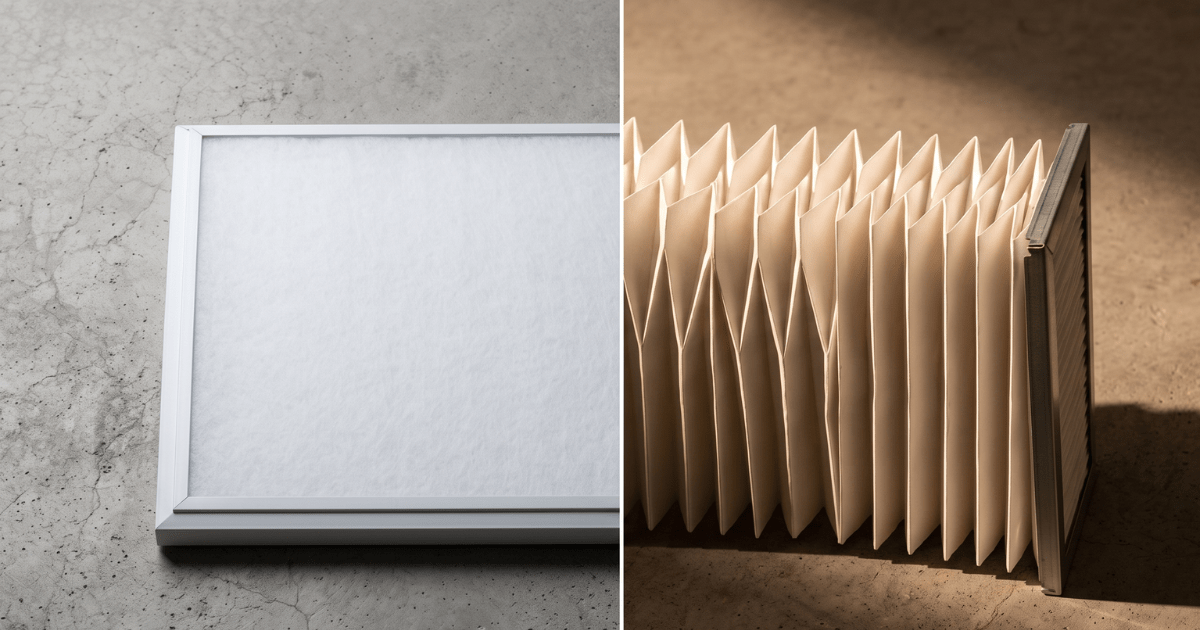
For most inlet positions, the choice comes down to flat panel filters versus concertina paper filters. Flat panels come in fibreglass or synthetic media. Fibreglass panels are the economical option and perform well in cleaner environments with regular replacement. Synthetic panels cost slightly more and offer higher dust holding capacity, better consistency, and more reliable performance where intake air quality varies. Synthetic polyester filter media offers a greater array of performance and choice.
Concertina paper filters, such as the Andreae range, bring a pleated design to the inlet position. The pleats multiply the effective filtration surface many times over compared with a flat panel of the same face size. So when does that added capacity justify the added cost? The concertina design earns its place in three situations: high dust load environments where flat panels clog quickly, operations wanting longer replacement intervals to reduce maintenance downtime, and booths with tight airflow constraints where a slowly loading filter keeps intake pressure stable for longer.
If your booth sits in a sealed, clean workshop and you are disciplined about replacement, a quality flat panel will serve you well. If your booth draws air from a dusty industrial estate, a gravel yard, or anywhere near unsealed roads, the concertina option usually pays for itself in fewer changes and steadier airflow.
Exact Sizing Is Not Optional
Whatever media you choose, sizing decides whether it works. A pre filter that does not seal the intake opening lets air bypass the media entirely, and bypass air is unfiltered air. A gap of just 10mm around a poorly fitting inlet filter is enough to allow significant dust contamination into the booth on every cycle. The filter can be premium grade and freshly installed, and the booth will still be breathing dirty air around its edges.
This is a genuine problem in the Australian market because inlet dimensions vary enormously between booth makes and models. Older booths, imported booths, and modified installations frequently have intake openings that no standard catalogue size matches properly. Operators respond by folding filters to fit, doubling up undersized panels, or leaving gaps, and all three approaches compromise the seal. Measure the actual opening, not the old filter, since the previous filter may have been the wrong size all along.
Get the Replacement Frequency Right
Replacement intervals at the inlet catch many operators by surprise. In outdoor adjacent booths or dusty industrial environments, inlet filters may need changing more frequently than exhaust filters, which is the opposite of what most people assume. The exhaust wall loads at the rate you spray, but the inlet loads at the rate your environment delivers dust, and those two rates are unrelated.
Remember also that pre filters load internally before they look dirty on the surface. Judging by appearance means running degraded airflow for weeks without knowing it. Set your interval based on the environment and measured pressure drop where possible. As a working rule, review inlet filter conditions every time you change any other filter in the booth, and track how quickly they load so your schedule reflects reality rather than habit.
There is a cost logic to getting this right. A neglected pre filter passes dust that loads your ceiling media early, and ceiling media costs considerably more per change than inlet media does. Frequent inexpensive inlet changes protect infrequent expensive downstream changes. Operators who track filter spend across the whole system, rather than per filter, consistently find that disciplined inlet replacement lowers their total filtration cost.
A Quick Buying Checklist
Before you order, confirm five things. First, the environment: how dusty is the air your booth actually draws? Second, the media: flat panel for cleaner conditions and simple economics, concertina for high dust loads, longer intervals, or tight airflow constraints. Third, the dimensions: measured from the intake opening itself, for every opening the booth has.
Fourth, the replacement plan: an interval based on your environment, not on how the filter looks. Fifth, the supplier: one who will cut to size, hold local stock, and give straight answers about what your booth needs.
Where AeroFlow Filters Fit In
AeroFlow Filters supplies custom cut inlet filters to exact dimensions for any booth make and model, across fibreglass panels, synthetic panels, and Andreae concertina options. Because stock is held in Australia and dispatched fast, correctly sized pre filters arrive when you need them rather than weeks later. And because the AeroFlow Filters team works with spray booth filtration every day, you get direct guidance on which media suits your environment instead of a generic catalogue response.