How often should you replace spray booth filters?
It depends on the position and your production volume, because each position loads at a different rate. As a general starting point, exhaust filters are changed every 2 to 8 weeks, floor filters every 4 to 12 weeks, ceiling or plenum filters every 6 to 12 months, and intake or pre filters every 4 to 12 weeks depending on how dusty the surrounding environment is. The more reliable trigger is pressure drop rather than time. Change exhaust filters when your manometer reads approximately 0.5 inches water gauge, around 125 Pascals, above the clean filter baseline you recorded when they were new. The operating guidelines for the booth will often have this detail as well.
Ask ten Australian shops how often they change their filters and you will get ten answers, most of them based on habit rather than measurement. The common approach is to change everything at once on a rough schedule, which sounds tidy but is almost always wrong. It over replaces the positions that load slowly and under replaces the ones that load fast, so you spend more than you need while still running degraded filters where it matters most.
This guide breaks the schedule down by position and production volume, so you can replace each filter when it actually needs replacing.
Why Each Position Wears at a Different Rate
The positions in a booth face completely different loads. Exhaust filters take the full paint overspray burden, so their life is driven by how much coating you spray rather than by how many days pass. Floor filters in downdraft booths catch overspray falling below the work piece and also carry foot traffic and equipment weight, so coating volume and physical wear drive them together. Intake and pre filters catch environmental dust rather than paint, so their life is driven by conditions outside the booth, which means a shop on a dusty industrial estate loads pre filters faster than one in a sealed suburban workshop.
Once you see that, the flaw in a single blanket interval becomes obvious. Three different drivers cannot produce one correct answer. What they can produce is three separate intervals, each anchored to something measurable.
Spray Booth Filter Replacement Intervals by Position and Production Volume
Save or print this table and keep it beside the booth. Treat the intervals as working benchmarks to be adjusted against what your pressure readings and your finish quality tell you.
| Filter position | Light use (1 to 5 jobs per week) | Medium use (6 to 15 jobs per week) | Heavy use (15+ jobs per week) | Primary loading driver |
| Exhaust filter | 6 to 8 weeks | 3 to 5 weeks | 1 to 3 weeks | Volume of coating sprayed |
| Floor filter (downdraft) | 10 to 12 weeks | 6 to 9 weeks | 3 to 5 weeks | Coating volume plus foot and equipment traffic |
| Intake or pre filter | 10 to 12 weeks | 6 to 10 weeks | 4 to 8 weeks | External dust load and season |
| Ceiling or plenum filter | 12 months | 9 to 12 months | 6 to 9 months | Cumulative air volume and pre filter condition |
Three adjustments are worth making straight away. Shorten the exhaust interval if you spray high solids or heavy build coatings, because those load media faster than the job count alone suggests. Shorten it again if you have moved to waterborne, since the higher application volumes these systems often require push more material through the media, and plenty of operators expect the opposite. Shorten the intake interval and review it seasonally if your booth sits near an unsealed yard, a construction site or a busy road, because pollen in spring and dust through a dry summer will change the answer.
Pressure Drop, the Trigger That Actually Tells You
Time based intervals are useful for ordering and planning, but pressure drop is what tells you the truth about a filter. Your booth’s manometer measures the resistance across the filters, and as media loads with overspray or dust that resistance climbs. Record the reading when the filters are brand new, which is your clean filter baseline, then change the exhaust filters when the reading rises approximately 0.5 inches water gauge above that baseline, which is around 125 Pascals.
Some setups can run further. Booths with variable frequency drive systems can often extend to 0.75 or even 1.0 inches water gauge on a single stage exhaust filter, because the drive compensates for rising resistance. Andreae concertina media is rated to withstand a pressure drop of just over 1.0 inches water gauge, though running to the media’s structural limit is not the same as running to the point where booth performance is still acceptable. If you are unsure what your booth tolerates, the conservative 0.5 inch trigger is the safe default.
The critical part is recording the baseline. A manometer reading in isolation means nothing, because it is the change from clean that matters rather than the absolute number. Write the clean reading on a label beside the gauge the day you fit new filters and the whole system becomes usable by anyone in the shop.
One caution. If your readings look suspiciously stable across weeks of heavy work, check the booth itself before you trust them. Worn door seals and failing gaskets let unfiltered air in around the filters, which holds the gauge steady while contamination reaches the panel anyway.
What to Look For Between Readings
Not every booth has a working manometer, and even where one exists a quick visual check catches problems between readings.
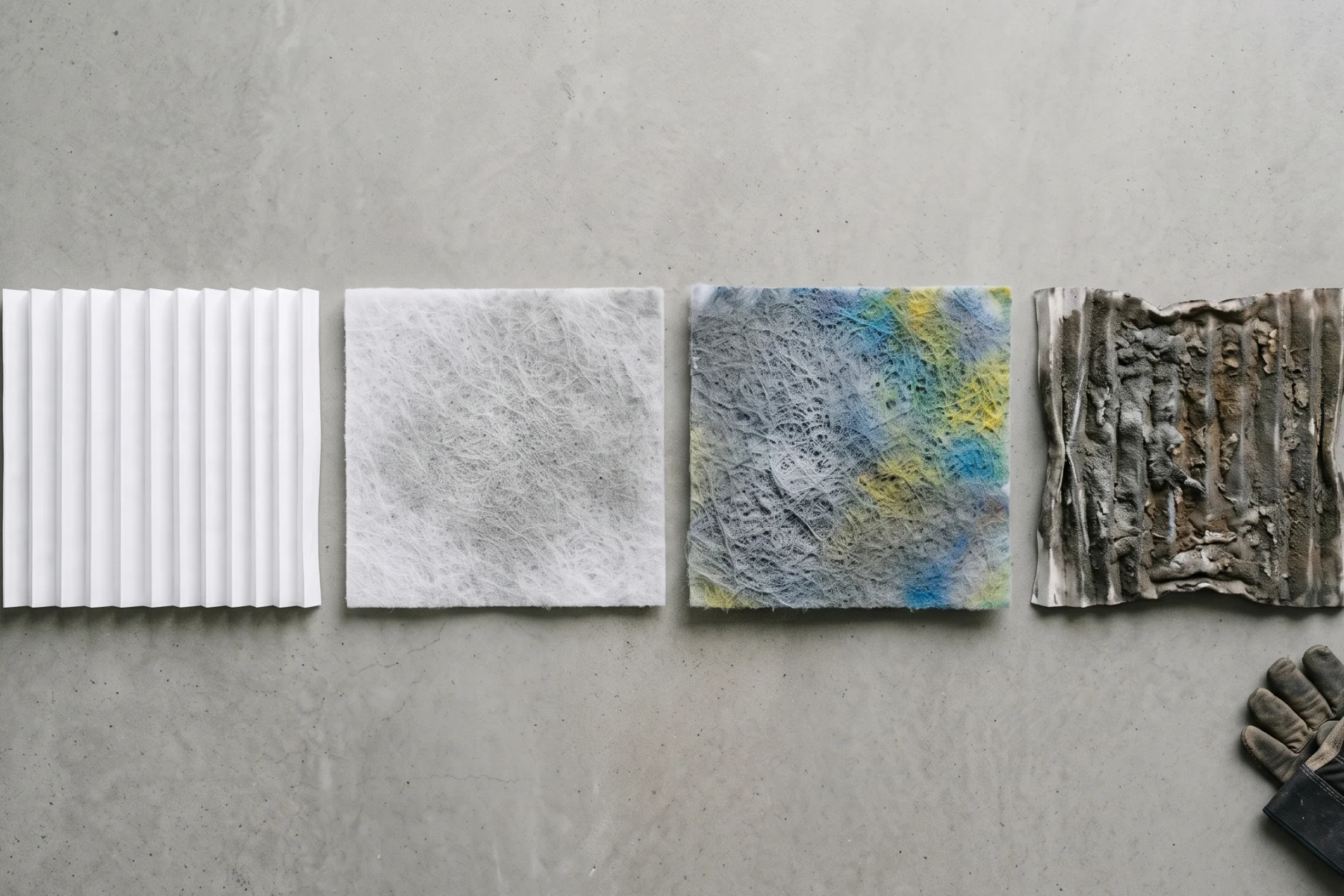
For exhaust media, look for colour saturation showing through the back face of the filter, which means overspray has penetrated the full media depth. Look also for sagging, deformation or structural collapse, since a filter losing its shape under airflow pressure is already letting air past its edges.
For floor filters, check for compression under foot traffic, torn sections around grate edges, and any channel forming between the media and the frame. For ceiling media, look for tears, sagging between grid supports and visible dust fall. For intake and pre filters, resist judging by appearance, because pre filters load from within the media and can look reasonably clean while airflow has already dropped well below spec.
Finish quality is an indicator in its own right. If defects appear without any change to product, technique or prep, the booth is the variable. Mist or fallback in the spray zone points at the exhaust side, and spray cycles take longer to clear at reduced airflow.
An Overdue Exhaust Filter Is a Safety Issue, Not Just a Quality One
A blocked exhaust filter reduces the airflow that carries solvent vapour out of the spray zone, which allows flammable vapour to accumulate where people are working. That makes filter conditions part of your ventilation obligations under the model WHS laws, not just a finish quality question. It is also the position most likely to be looked at if your state regulator or insurer ever asks how the booth is maintained.
Keeping the log described below is the cheapest form of evidence you will ever produce.
Building a Schedule You Will Actually Follow
The most effective schedules are the simplest ones. Set a recurring reminder for each position based on your production tier, then record the date and the clean manometer reading every time you change a filter. Over three or four cycles your own data will beat any published benchmark, because it reflects your coatings, your climate and your workload. Keep the log somewhere visible near the booth rather than in a folder on someone’s desk.
Set inspection intervals as well as replacement intervals. In a busy shop the exhaust position warrants a weekly look, while intake, floor and ceiling positions are fine monthly. If you do not track job counts closely, litres of paint consumed works as a secondary anchor for the exhaust position, calibrated against your own first few change cycles.
The final piece is supply. A schedule fails the moment the filter is not on the shelf when the reminder goes off, and an emergency order mid job costs far more than the filter. Keeping one change of each position in stock turns a planned replacement into a five minute task instead of a shutdown.
Set Up Scheduled Ordering and Stop Thinking About It
AeroFlow Filters can supply on a scheduled order so replacements arrive ahead of when you need them. Tell us your booth type, your positions and your production tier and we will build the schedule around them.
Frequently Asked Questions
How often should you replace spray booth filters?
It depends on position and production volume. As a starting point, exhaust filters are changed every 2 to 8 weeks, floor filters every 4 to 12 weeks, intake or pre filters every 4 to 12 weeks, and ceiling or plenum filters every 6 to 12 months. Heavy production shops sit at the short end of every range. Pressure drop across the filters is a more reliable trigger than any calendar interval.
What is the correct exhaust filter replacement frequency?
For a light use booth running 1 to 5 jobs per week, 6 to 8 weeks is typical. For medium use at 6 to 15 jobs per week, expect 3 to 5 weeks. For heavy production above 15 jobs per week, 1 to 3 weeks is common. Spraying high solids or heavy build coatings shortens all of these, because coating volume rather than job count is what loads exhaust media.
What pressure drop reading means it is time to change spray booth filters?
Change exhaust filters when the manometer reads approximately 0.5 inches water gauge, around 125 Pascals, above the clean filter baseline recorded when the filters were new. Booths with variable frequency drive systems can often extend to 0.75 or 1.0 inches water gauge. The baseline matters more than the absolute number, so record the clean reading every time you fit new filters.
Can spray booth filters be cleaned instead of replaced?
Paint overspray filters cannot be cleaned. The media captures overspray within its depth and that material cures in place, so cleaning cannot restore airflow and attempting it usually damages the media structure. Exhaust, floor and concertina paper filters are all single use consumables. Some coarse intake pre filters can be lightly vacuumed to extend life slightly, but this is a stopgap rather than a substitute for replacement.
Why do my exhaust filters load faster than my inlet filters?
Because they are catching different things. Exhaust filters capture paint overspray, and the volume of that is driven directly by how much coating you spray. Inlet and pre filters capture environmental dust, and their loading rate is driven by conditions outside the booth. In a busy shop in a clean environment the exhaust filter will always be the faster of the two, while a shop beside an unsealed yard may find the reverse in summer.
Should I change all my spray booth filters at the same time?
No. Changing everything on one interval over replaces slow loading positions such as ceiling media and under replaces fast loading positions such as exhaust media. That costs money on one side and finish quality on the other. Run a separate interval for each position, anchored to a pressure drop reading wherever you have a manometer.
How do I know if my spray booth filter needs changing without a manometer?
Use visual indicators, but treat them as second best. For exhaust media, look for colour saturation showing through the back face and any sagging or structural collapse. For floor filters, check for compression, tears and channels forming at the grate edges. For intake filters, do not judge by appearance, because pre filters load internally and can look clean while airflow has already dropped. In the absence of a gauge, set a conservative interval from the table above and stick to it.