Why does exact filter fit matter in a spray booth?
Air always takes the path of least resistance. A gap around the edge of a filter offers almost no resistance compared with passing through the media, so a disproportionate share of the air stream goes around the filter rather than through it. Even a small gap therefore lets unfiltered air into your booth on every cycle, contaminating the finish and loading downstream equipment with particles it was never designed to handle. Custom cut filters are cut to your booth’s actual opening dimensions rather than a manufacturer’s standard sizes, which removes the gap entirely.
Here is a problem almost every Australian spray booth operator recognises. You order the closest standard size filter to your opening, it arrives slightly small, and you fit it anyway because the alternative is a booth sitting idle. Perhaps you pack the edges with something, perhaps you just accept the gap. Either way the booth runs, work goes out, and nobody thinks about it again.
The booth is now running with a permanent leak. Leaks in a filtration system have consequences, and they show up somewhere else entirely.
Why Standard Sizes So Often Do Not Fit
Off the shelf filters are made to common HVAC panel dimensions such as 595 x 595mm, 490 x 490mm and 595 x 290mm. Those sizes exist because they suit a lot of commercial ventilation equipment. They were never designed around the spray booth market.
Brand affiliated filters are no better if your booth is not current. Most are cut to suit that manufacturer’s own recent models, so older booths, imported booths, booths from brands no longer trading in Australia, and booths retrofitted over decades all sit outside the grid.
Then there is the practical reality of a working booth. Frames get bent, openings get modified, extraction gets upgraded, and door vents get added. A booth that left the factory as a standard size may not be one any more. Measuring what you actually have, rather than what the model number says you should have, is the only reliable starting point.
What a Gap Actually Does
The instinct is that a few millimetres around a large panel cannot matter much. That instinct underestimates how air behaves. Filter media exists precisely to create resistance, so any open edge becomes the preferred route and the bypass share of the airflow runs well ahead of the bypass share of the area. This is also why you cannot fix a fit problem by upgrading media grade. A high efficiency filter with a gap around it does less work than a coarser filter that seals properly.
The consequences differ by position. At the intake or ceiling, bypass means workshop dust, insects and debris entering the booth and landing on wet paint, which shows up as nibs and inclusions. At the floor, bypass means overspray passing into the extraction plenum instead of into the media, which builds up in ductwork and creates both a maintenance job and a fire risk. At the exhaust, bypass means paint particles reaching your fan, ducting and ultimately the atmosphere, which is a compliance concern as much as a mechanical one. None of these show up on the day you fit the filter, which is exactly why the habit persists.
The Hidden Cost of Almost Right
Poor fit is expensive in ways that rarely get attributed to it. Rework is the obvious one, because a contaminated panel means flatting, respraying, more material, more booth time and a delayed job. Less obvious is what bypass does to your other filters, since particles that should have been caught at the intake go on to load ceiling and exhaust media early, shortening the life of every filter behind the leak. Extraction fans and ductwork accumulate overspray they were never meant to see, which turns into a cleaning cost and eventually a mechanical one.
There is also an airflow argument. A booth designed to deliver a given face velocity assumes air passes through the media as intended. When a meaningful share of it short circuits around the edges, the airflow pattern changes shape and creates turbulence across the work piece. That is a finish quality problem no amount of gun technique will fix, and one of the harder faults to diagnose because everything looks normal. Add a year of rework, early filter changes and duct cleaning together and the savings on a cheaper standard size filter disappears quickly.
What a Custom Cut Filter Needs From You
Four pieces of information cover almost every order.
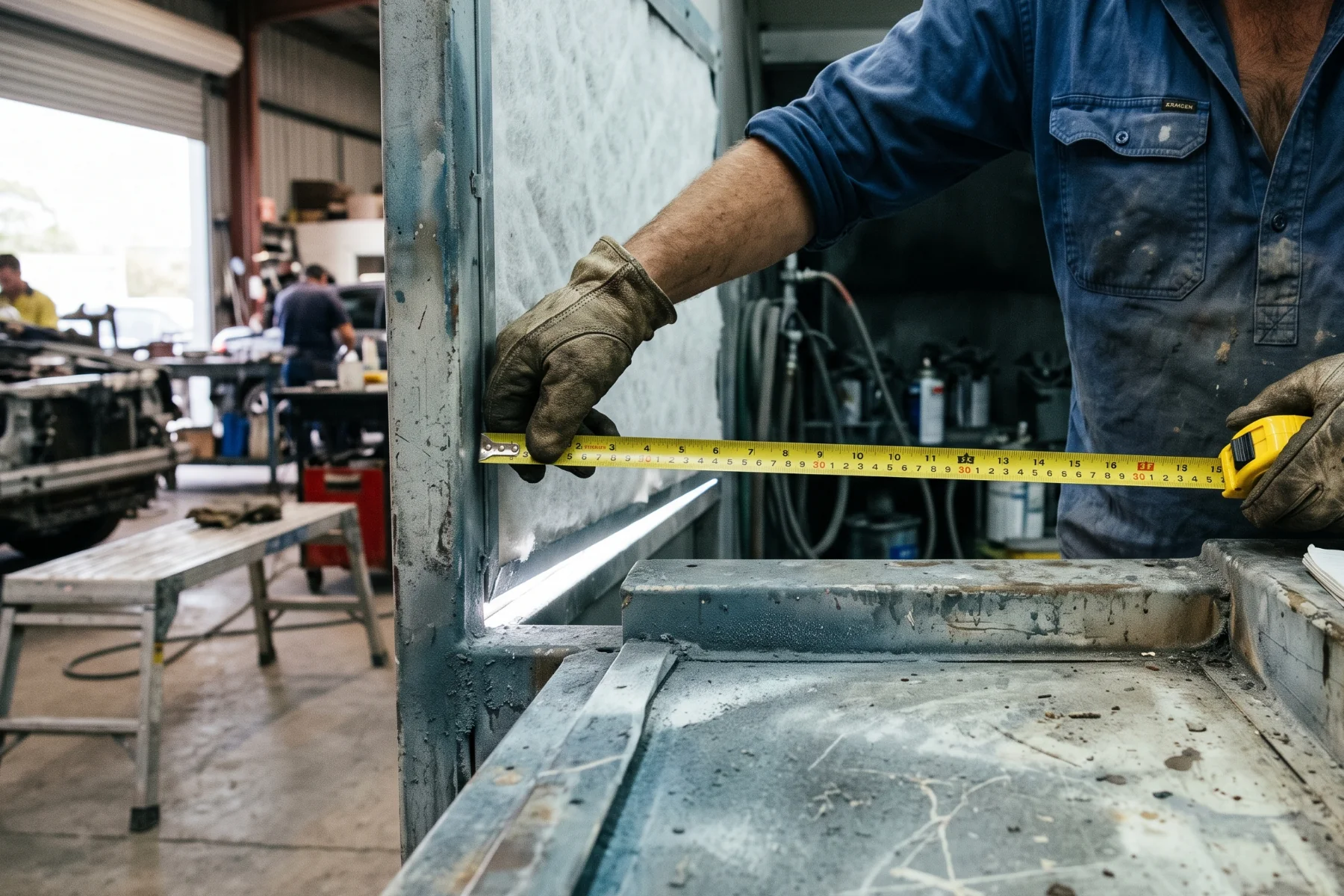
Face dimensions. Width and height of the internal frame opening in millimetres. Measure the opening, not the filter currently in it, because the filter in place may already be the wrong size.
Depth or thickness. This decides whether the media seats in the channel and whether the holding frame closes flush. Get it wrong and the frame either will not close or the filter shifts during operation.
Media type for that position. Intake and pre filter positions, ceiling media, floor media and exhaust media each do a different job and each has its own specification.
Frame or format. Individual panels in a cardboard frame suit standard replacement cycles. A moisture resistant board suits humid environments. Steel or aluminium framing suits high load industrial positions. Some positions take continuous roll cuts to length instead of panels.
How to Measure Spray Booth Filters, Position by Position
Take every measurement in millimetres and write it down at the booth rather than trusting memory back at the desk. If an opening is not perfectly square, measure it at both ends and note the difference rather than averaging it. Measure each bay individually, because bays that look identical often vary by a few millimetres depending on how the booth was installed.
| Position | Measure | Watch for |
| Intake and pre filter | Clear internal dimensions of the intake frame or grille housing | Media often needs to sit slightly larger than the visible opening to seat against the channel lip. Include door vents and roof intakes, since one unfiltered secondary intake undoes the rest |
| Ceiling and plenum | Total length and width for roll media, or one grid cell plus the cell count for panels | Edge cells in a grid are frequently cut down and are not the same size as the rest |
| Floor | Internal dimensions of each grate opening, not the grate itself | Media must fill the opening completely. A bypass channel at a grate edge feeds overspray straight into the extraction plenum |
| Exhaust | Clear opening of the exhaust wall or each exhaust frame, plus roll width and total run where applicable | Note the pleat depth the frame accommodates if you run concertina media |
Measure twice. Filters cut to your specification cannot be returned for a refund if the dimensions supplied are incorrect. If you are unsure whether you have measured an opening correctly, say so when you send the numbers through. A second pair of eyes before anything is cut costs nothing.
How Ordering Custom Cut Filters Works
The process at AeroFlow Filters is deliberately simple. Send through your position by position measurements along with your booth type and the media you want at each position, and the team confirms the specification back to you before anything is cut. Filters are cut to your dimensions from the same media families available in standard sizes, so choosing custom does not mean compromising on media quality or performance. Custom cut is available across fibreglass, polyester and inlet media, and the Andreae concertina range covers non standard exhaust walls through roll formats cut to length.
Filters Made to Fit Your System, Not the Other Way Around
That line is not marketing dressing, it is the actual argument. Your booth was built for your building, modified for your workflow, and repaired by whoever was available at the time. Expecting a filter cut for a different manufacturer’s current model to fit it precisely is optimistic. The alternative is not exotic or expensive, it simply means the supplier cuts to your numbers rather than asking you to work around theirs.
Once your measurements are on file the ongoing benefit compounds. Reordering becomes a single message rather than a fresh round of guesswork, every filter that arrives fits the first time, and the whole set stays consistent in thickness and seating. That is the point at which filtration stops being a recurring annoyance and becomes a maintenance line item that simply works.
Get your booth measured up properly. Send your dimensions to AeroFlow Filters for a custom cut quote.
Frequently Asked Questions
What are custom cut spray booth filters?
Custom cut filters are filter media cut to the exact dimensions of your booth’s openings rather than to a manufacturer’s standard size grid. They are cut from the same media families available in standard sizes, so there is no compromise in media quality or performance. AeroFlow Filters supplies custom cut options across fibreglass, polyester, inlet media and G4 media, plus Andreae concertina in roll formats cut to length.
Does a small gap around a spray booth filter really matter?
Yes, more than most operators expect. Air follows the path of least resistance, and filter media exists to create resistance, so an open edge becomes the preferred route for the air stream. The share of air bypassing the filter is therefore much higher than the share of the opening the gap represents. On every cycle, that unfiltered air carries contamination into the booth or overspray into your ductwork.
How do I measure my spray booth for custom cut filters?
Measure the opening rather than the old filter, because the existing filter may be the wrong size already. Record width, height and media thickness in millimetres for every position, including intakes, ceiling, floor grates and exhaust. Check the openings that are easy to forget, such as door vents and roof intakes. If an opening is not square, measure both ends and note the difference rather than averaging it.
Why do standard size filters not fit my booth?
Off the shelf panels are made to common HVAC dimensions that were never designed around spray booths, and brand affiliated filters are cut to suit specific manufacturers’ current models. Older booths, imported booths, booths from brands no longer trading in Australia and booths retrofitted over the years all fall outside both grids. Working booths also change over time as frames bend, extraction gets upgraded and vents are added.
Which filter positions can be supplied with a custom cut?
All of them. Intake and pre filter positions, ceiling and plenum media, floor filter media and exhaust media can all be supplied cut to size. Custom cutting is available across fibreglass, polyester and inlet media types, so you can specify the correct media for each position and still get an exact fit.
How do I order custom size paint booth filters in Australia?
Send your position by position measurements, booth type and preferred media to AeroFlow Filters, and the team confirms the specification back to you before cutting. You can order online, call 1800 99 88 76, or email sales@aeroflowfilters.com. Once your measurements are on file, reordering becomes a single message rather than a fresh round of measuring.
Is it cheaper to use a standard size filter that almost fits?
Usually not, once the full cost is counted. Bypass around a poorly fitting filter causes rework from contaminated panels, shortens the life of every filter downstream of the leak, and deposits overspray in fans and ductwork that then needs cleaning. Across a year those costs typically outweigh the difference in unit price.