Most spray booth operators know one or two filter positions well and the rest barely at all. The exhaust wall gets changed because overspray makes the loading obvious. The ceiling filters get changed when finish quality slips. The inlet filter often gets forgotten entirely.
Yet a spray booth is a single connected air system, and every filter position affects every other. This guide follows the air on its full journey through the booth, from the moment it is drawn in to the moment it leaves, explaining what each filtration stage does, which media types belong there, and how to know when each filter needs changing.
Think of it as the reference document for your whole system. Whether you are diagnosing a stubborn finish problem, refitting a booth from scratch, or training a new team member, this is the complete picture in one place.
How Air Moves Through a Spray Booth
Before looking at individual filters, picture the airflow path. Outside air is drawn in through the intake, passes through inlet filtration, and is distributed through the ceiling or plenum into the spray zone. There it flows down and around the job being painted, picking up overspray as it goes. In a downdraft booth the air continues through floor filters beneath the vehicle, while in crossflow and semi downdraft designs it moves horizontally toward the rear or sides of the booth. Finally, the air passes through exhaust filtration, where remaining paint particles are captured before the air exits the booth.
A useful diagram for this page would show a side on cutaway of a downdraft booth with numbered arrows tracing this exact path: intake at the top or side, ceiling plenum, spray zone with a vehicle silhouette, floor extraction pit, and exhaust stack. Our design team will prepare this visual, but the sequence itself is worth memorising. Four stages, one continuous stream of air. When any stage degrades, the whole system feels it.
Stage 1: Inlet Filters and Pre-Filters
The first stage is the inlet filter, also known as the pre filter, installed at the air intake. Its purpose is to capture coarse airborne dust, debris, insects, and larger particles before they enter the booth environment. This is deliberately coarse filtration, since the fine work happens later. The inlet stage protects both your paint finish and every downstream filter from contamination that should never get inside.
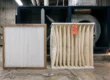
Three media types dominate this position. Fibreglass panel filters offer economical coarse capture for cleaner environments. Synthetic panel filters step up the dust holding capacity and consistency for a modest premium. Andreae concertina paper filters bring pleated depth to the inlet, suiting high dust load sites and operations that want longer intervals between changes. AeroFlow Filters supplies all three, custom cut to the exact intake dimensions of any booth make and model.
Replace inlet filters on schedule or on measured pressure drop rather than on appearance, because they load internally long before they look dirty. In dusty environments, expect to change them more often than your exhaust filters. For the full treatment of this stage, see our inlet filter guide and pre filter buying guide.
Stage 2: Ceiling and Plenum Filters
The second stage is the main ceiling filter, sometimes called the plenum or diffusion filter. This is the primary filtration of air entering the spray zone, and it is the stage that most directly protects your paint work. Ceiling filters remove the fine particles that survived the inlet stage and distribute air evenly across the booth so it falls in a smooth, laminar flow over the job. Uneven or turbulent ceiling airflow can cause as many finish problems as dirty air does.
Ceiling media is typically a fine synthetic material, often with a tack coating on the downstream face that holds captured particles in place so they cannot shed onto wet paint. Quality matters more here than anywhere else in the system, since this is the last filter the air passes before it touches your finish. AeroFlow Filters stocks ceiling and plenum media in formats to suit all booth brands, in both cut to size pieces and full rolls.
The replacement indicators for this stage are finish quality and airflow. Rising dust counts in fresh paint, visible discolouration of the media, or falling downward air velocity all signal that the ceiling filter is due. Many operators tie ceiling filter changes to a fixed calendar interval and adjust based on experience, which works well provided the interval is honest.
Stage 3: Floor Filters
The third stage applies to downdraft booths, where air leaves the spray zone through the floor. Floor filters sit in the extraction pit beneath the grating and capture overspray in the spray zone itself, arresting paint particles as the air is drawn downward and away from the job. This position takes a heavy and constant overspray load, because it is the first capture point after the spray gun.
Media at this stage is typically fibreglass paint arrestor material supplied in rolls or pre cut pads, chosen for high paint holding capacity and progressive depth loading. Because floor filters load faster than any other stage in a busy downdraft booth, accessibility and quick changeover matter. Watch for rising booth pressure, sluggish extraction, and overspray beginning to settle in the booth rather than being pulled down and away. All three indicate loaded floor media. Booth designs continue to evolve. Floor filters in newer booth designs can utilise Paint Pocket Filter media or Ecoguard.
AeroFlow Filters supplies all types of floor filter media cut to suit the pit dimensions of any downdraft booth, so changeovers are a drop in job rather than a trimming exercise.
Operators of crossflow booths can skip this stage, since their airflow path runs horizontally to the exhaust wall instead.
Stage 4: Exhaust Filters
The final stage is exhaust filtration, the last capture point where remaining paint particles are removed before air exits the booth. This stage carries a compliance dimension as well as a performance one, since the air leaving your stack affects your neighbours, your workplace, and your obligations. A degraded exhaust stage also allows overspray into ducting and fans, where it accumulates as a costly and flammable maintenance problem.
A number of newer booth designs effectively combined stage 3 and 4. This allows a lower capital cost, improved efficiencies and more exhaust media choices.
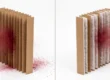
Several proven media options serve this position. Fibreglass flat sheet media is the traditional paint arrestor, economical and effective with regular changes. Ecoguard media offers engineered multi stage arrestance with high holding capacity. Paint Pocket media provides a high capacity option well suited to heavy overspray operations.
Andreae concertina paper filters also serve exhaust dry filtration, and their story is told in our brand history piece. AeroFlow Filters stocks all of these formats in Australia and can match the media to your booth format, overspray volume, and coating types.
Replacement indicators here are pressure drop across the exhaust wall, visible breakthrough of paint on the clean side, and reduced extraction performance. If your booth has a manometer, use the manufacturer’s recommended change point. If it does not, fitting one is one of the cheapest performance upgrades available. Running exhaust media past its capacity also forces fans to work harder against the resistance, lifting energy consumption for every hour the booth runs. Timely changes protect compliance, equipment, and running costs all at once.
Reading the System as a Whole
Understanding the stages individually is useful, but the real diagnostic power comes from reading them together. Persistent dust in the finish points upstream to the inlet and ceiling stages. Overspray drifting in the spray zone points downstream to floor or exhaust loading. Filters at one stage loading much faster than usual usually means the stage before it is passing contamination it should be catching. Before blaming paint, technique, or equipment, walk the air path from intake to stack and check each stage in sequence.
The same system view applies when setting up or refitting a booth. Specify all four positions together, matched to your environment and workload, rather than copying whatever was in the booth when you bought it. A balanced system where each stage does its own job costs less to run than one where premium filters compensate for neglected positions. This is also the moment to standardise sizes and set a replacement calendar for every position, so maintenance becomes routine rather than reactive.
A written filter schedule pays for itself quickly. List every position in the booth, the media specified for it, the dimensions, the expected interval, and the actual change dates as they happen. Within a few months the schedule tells you how your booth really behaves in your environment, which positions load faster than expected, and where your filtration budget actually goes. It also makes handovers painless when staff change, since the knowledge lives in the document rather than in one person’s head.
One Supplier for Every Position
The practical advantage of the system view is that you can source it all in one place. AeroFlow Filters supplies fit for purpose filters for every booth type and every filtration stage, from inlet panels to ceiling media, floor rolls, and exhaust arrestors, regardless of booth brand. Custom sizing covers non standard openings at any position. Stock held in Australia ships with fast dispatch, and the local team gives direct answers grounded in daily spray booth filtration experience.
If any stage of your system is underperforming, or you simply want confidence that the whole path is specified correctly, AeroFlow Filters can audit the full setup and recommend a complete filter schedule for your booth.