Every clogged filter steals airflow. It really is that simple.
When your exhaust media chokes, booth pressure spikes. Suddenly, the clean, uniform downdraft you rely on turns into a turbulent mess, dragging overspray and dust directly onto a fresh clear coat. That means re-sanding, repainting, and chucking profit right out the window.
If you are running a high-volume panel shop or an industrial coating line, you cannot afford to guess about your fibreglass exhaust filter spray booth setup. You need to know exactly what media goes into the floor or walls, how much paint it can hold before it fails, and when to swap it out.
This guide breaks down exactly how to select the right media, how to handle fitment issues for older or highly specific machines, and precisely when to schedule your filter changes.
As Australia’s trusted spray booth filtration specialists, AeroFlow Filters doesn’t just sell rolls of glass. We solve airflow problems.
The Hidden Costs of Poor Filtration (Why Airflow is King)
Most shops look at exhaust filters as a basic consumable. A box to tick. But treating them as an afterthought is the fastest way to throttle your output.
Downtime & Rework
Here is the mechanical reality. A spray booth relies on balanced pressure. When your exhaust filters fill up with paint solids, the exhaust fan has to fight to pull air through the restricted media. This creates localised turbulence inside the cabin. Instead of overspray being pulled cleanly away from the job, it lingers. It swirls. Then it settles right back onto the wet panel.
You end up paying your technicians to buff out defects that never should have been there in the first place.
Health, Safety & Compliance
This isn’t just about glossy finishes. For Facilities Managers and industrial procurement teams, it is about staying out of trouble. Strict Australian standards govern airborne contaminants and exhaust emissions. If your booth is spitting solvent fumes or particulate matter into the workshop (or out into the neighborhood) you are risking massive fines.
Properly spec’d filtration creates safer, cleaner environments for your staff and keeps the environmental regulators off your back.
Equipment Strain
A clogged filter is a fan motor’s worst enemy. When airflow is blocked, resistance skyrockets. The fan motor works twice as hard to move half the air, running hotter and drawing more current. Over time, this bakes the motor windings and leads to premature, catastrophic fan failure. Replacing a burnt-out 3-phase exhaust motor will cost you a lot more than a roll of filter media.
Selecting the Right Fibreglass Exhaust Filter for Your Spray Booth
Not all green-and-white glass media is created equal. Grabbing whatever is cheapest at the local hardware supplier usually ends in disaster. You need media engineered specifically for the type of coatings you spray.
Technical Specifications that Matter
You have to look at two main things: micron capture efficiency and paint holding capacity.
Different paints behave differently. Modern water-based paints dry much faster in the air than older solvent-based enamels. By the time water-based overspray hits the floor filter, it is often a dry, dusty powder. Solvent overspray stays wet and sticky.
To handle this, you need a graded-density fibreglass matrix.
What does that mean? The fibers are loosely packed on the air-entry side (the green side) and get progressively tighter toward the air-exit side (the white side). This allows the filter to capture paint overspray deep inside the pad rather than just blocking the surface—a problem known as “face-loading.” Depth-loading media catches more paint, lasts longer, and maintains steady airflow.
Overcoming the Fitment Objection
“Will this actually fit my machine?”
We hear it constantly. Maybe you are running a 25-year-old Italian downdraft booth. Maybe you are managing a massive, custom-built marine coating facility in Western Australia where standard sizes just don’t work.
You aren’t restricted to standard off-the-shelf sizes. AeroFlow Filters cuts directly to your requirements. We provide custom-sized filters designed to slot perfectly into aging, modified, or highly specialised equipment. If there is a gap around your filter, air will find it, bypassing the media entirely. Getting the size exactly right is non-negotiable.
AeroFlow Filters vs. OEM vs. Cheap Imports: The Performance Showdown
Let’s address the elephant in the room. Why buy from us instead of the manufacturer who built your booth, or the budget supplier undercutting everyone on price?
The OEM Question
“Is this as good as the original manufacturer part?”
Look, major OEM brands like Camfil make excellent filtration products. We respect their engineering. But AeroFlow Filters media is manufactured to meet or exceed those exact same OEM specifications for both airflow resistance and paint holding capacity.
The difference? You don’t have to wait six weeks for a shipping container from Europe. When a booth goes down, you need parts yesterday.
The Import Trap
Then there is the false economy of cheap imports.
It is tempting to save fifty bucks on a roll of exhaust media. Don’t do it. Low-grade, uncertified fibreglass is notoriously thin. Under the high static pressure of a commercial exhaust fan, these cheap filters simply collapse. Worse, they shed loose glass fibers back into the booth cabin, which will ruin a paint job instantly.
Investing in high-density, properly bound fibreglass media will drastically reduce downtime and lower your overall operational costs. It is that simple.
Spray Booth Exhaust Filter Replacement: Timing is Everything
Running a filter until it visually looks “full” is a rookie mistake. By the time the surface is completely caked in dry paint, your airflow has been compromised for days. Planning your spray booth exhaust filter replacement based on actual data is the only way to protect your workflow.
Signs of Failure
Don’t wait for a ruined paint job to tell you it’s time for a change. Watch for these three indicators:
- Visible paint bypass: Check your exhaust fan blades and ducting. If you see paint build-up on the fan, your filter has failed. It is letting solids pass right through.
- Lingering overspray fog: If you finish a pass and a cloud of paint hangs in the cabin rather than pulling quickly into the floor, your airflow is choked.
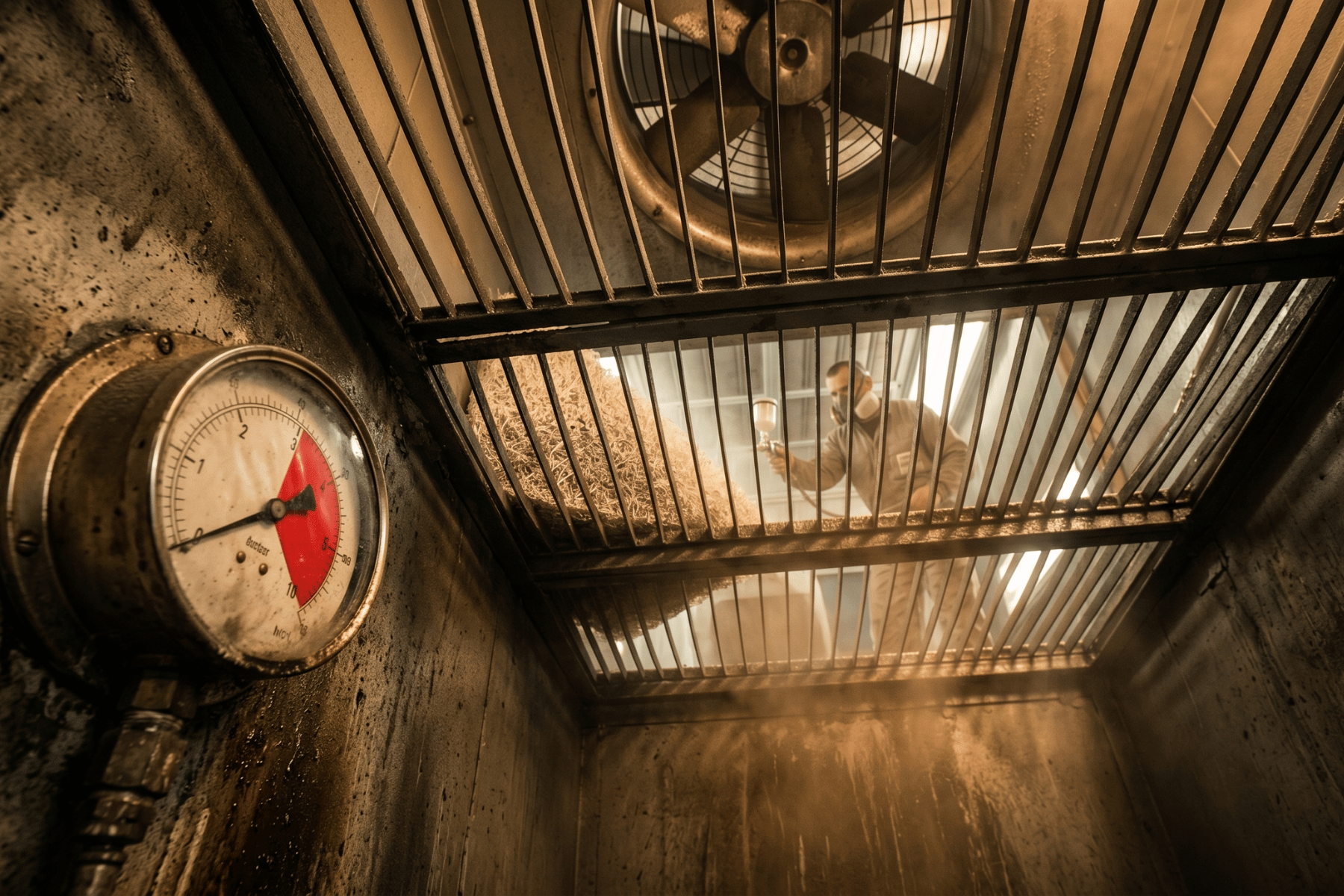
- Manometer pressure drops: This is the gold standard. A pressure gauge (manometer) measures the resistance across the filter. Depending on your booth specs, an increase of 50 to 100 Pascals (Pa) above the clean-filter baseline means it is time to change.
The 3-Step Replacement Checklist
When it is time to swap, do it right.
- Extract and Inspect: Carefully remove the loaded media. Inspect the metal grates and the plenum underneath. Vacuum out any settled dust before installing the new media.
- Cut and Place: Unroll the new media with the green side facing up (toward the painter). If you aren’t using pre-cut pads, ensure your cuts overlap the metal supporting grid by at least 20mm.
- Seal the Edges: A filter is only as good as its seal. Make sure the fibreglass sits flat against the holding frames. If edges curl up, high-velocity air will bypass the glass entirely, dragging paint straight into your exhaust fan.
Case Study: Reducing Rework by 25% in a High-Volume Panel Shop
Theory is great. Real-world results are better.
The Problem: A mid-sized Australian panel shop with 15 staff was bleeding money on buffing. Their output was bottlenecked because their floor filters were face-loading within just a few days of installation. The painter complained about poor downdraft, and the polishing team was working overtime to fix dirt inclusions and overspray dullness on finished panels.
The Solution: They ditched the cheap imported rolls and upgraded to AeroFlow Filters high-capacity, graded-density fibreglass exhaust media. More importantly, we helped the shop foreman implement a strict, pressure-based replacement schedule using their booth’s existing manometer.
The Result: The results were immediate. Because the AeroFlow Filters media captured paint deep within the pad, airflow remained consistent for twice as long. The shop saw a massive 25% reduction in buffing and rework time. As a bonus, their exhaust fan stopped overheating, significantly extending its operational lifespan.
Ready to Upgrade? Rely on Fast, Local Supply
Protecting your work, your equipment, and your staff requires the right filtration media, supplied exactly when you need it. You can’t put a shop on hold waiting for overseas shipping.
That is the AeroFlow Filters advantage. We hold extensive stock here in Australia, ensuring fast, local supply across the country. We know the local regulations, we understand the climate, and we know what it takes to keep an Australian workshop moving.
Whether you need bulk standard rolls to keep a fleet of booths running or custom-sized filters for a complex turnkey installation, our technical team is ready to help. Stop losing money on rework and dead motors. Contact the spray booth filtration specialists at AeroFlow Filters today to check local stock or request a technical data sheet.