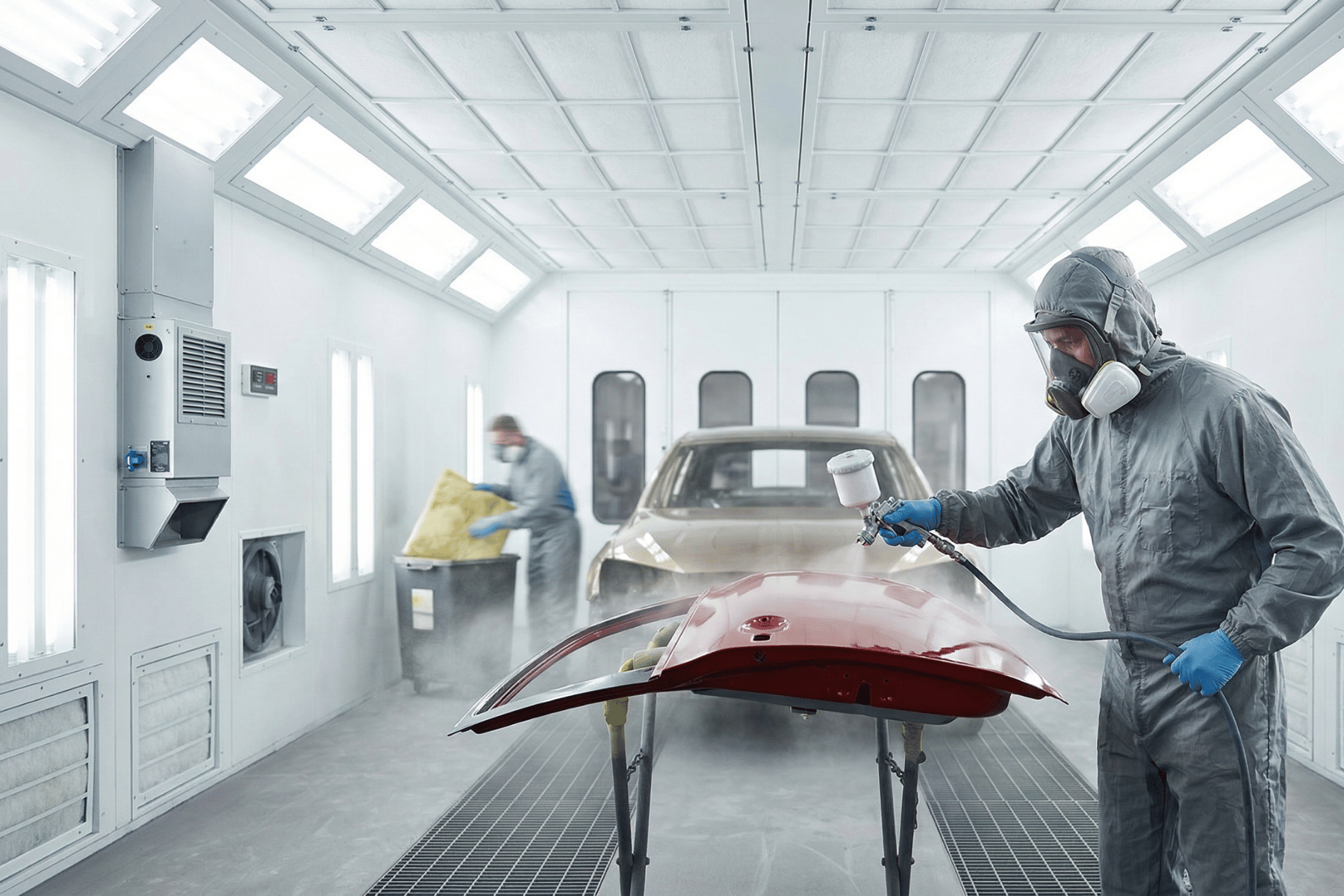
Most automotive panel beaters and industrial OEMs have already made the jump. Switching to waterborne paints just makes sense—it keeps you in line with tightening environmental regulations and meets strict OEM repair standards.
But here’s the problem no one talks about when you upgrade your paint system.
Many operators are still running spray booths with outdated filtration setups designed entirely for old solvent-based chemistry. The result? Dust nibs in the clear coat. Frustratingly long flash-off times. Jobs being pushed back.
We see it constantly. A shop invests thousands in premium water-based paint, only to run it through a booth that can’t handle the specific airflow requirements of the new chemistry.
At AeroFlow, we are spray booth filtration specialists. We know that when your finish is ruined by microscopic dust, you aren’t just losing a few liters of expensive paint. You are bleeding unbillable labor hours.
Every clogged filter steals airflow. And without optimal, high-velocity airflow, waterborne basecoats simply do not cure correctly.
How Waterborne Paints Change the Rules of Airflow
Let’s look at the actual chemistry. It dictates exactly why your booth is struggling.
Solvent-based paints dry largely through chemical evaporation. They are relatively forgiving when it comes to booth airflow. Water, on the other hand, evaporates much slower. Waterborne paints rely heavily on continuous, high-velocity, and highly consistent air movement physically passing across the painted panel to flash off the basecoat.
If your intake and exhaust filters are restrictive, or if they load up too quickly, your airflow drops. When airflow drops, the water sits on the panel. Your flash-off times blow out, bottlenecking your entire daily production schedule.
Then there is the issue of contamination.
Waterborne basecoats are incredibly sensitive to particulate contamination. Standard filtration ratings that worked fine for solvents ten years ago are no longer enough. You need absolute precision to catch microscopic dust before it hits the wet panel.
- Microns Matter: We are talking about particles you can’t see with the naked eye. If your ceiling intake filter isn’t rated to catch these sub-micron particles, they will end up in your clear coat.
- Airflow Optimization: Proper filtration isn’t just about blocking dust; it’s about regulating air pressure. The right media ensures uniform air distribution across the entire cabin.
- Industrial Impact: Large-scale industrial coaters and facility managers rely heavily on strict micron ratings. When you are processing massive volumes of parts daily, a 2% rework rate caused by poor filtration translates to tens of thousands of dollars in lost revenue.
The Downtime Trap: Substandard Imports vs. High-Performance Filters
Look, we hear the objection all the time. “Is a premium filter really worth the cost compared to the low-budget imports I can buy online?”
Honestly? Buying substandard filters is a classic false economy.
Inferior filters use cheap, single-stage media. They surface-load almost immediately. This means the dust coats the front of the filter like a blanket, entirely blocking the air from passing through. This leads to a rapid pressure drop inside your spray booth. Your fans have to work twice as hard to pull air, burning excess energy, and your booth stops clearing overspray effectively.
High-performance spray booth filters use progressive density media. The fibers are spaced wider at the front to catch large particles, and get tighter toward the back to trap the microscopic dust. The entire depth of the filter holds dirt, allowing air to keep flowing freely for much longer.
Consider a recent benchmark we ran with a medium-sized panel shop. They were dealing with high rework rates on water-based jobs.
- They upgraded their standard intake and exhaust filtration to AeroFlow media specifically designed to handle heavy waterborne output.
- The Result: They immediately cut rework by 14%.
- The Bonus: They extended their filter maintenance intervals by three weeks, significantly reducing labor spent changing out messy exhaust pads.
If you want to reduce downtime and keep your booth cycling cars efficiently, reliable filtration is the easiest, most cost-effective mechanical upgrade you can make.
Will it Fit My Older Spray Booth?
This is the next hurdle. You have an older, locally built spray booth, or a turnkey retrofit that’s been running reliably for fifteen years. You’ve switched to waterborne paints, but you’re worried your specific booth dimensions mean you’re stuck with whatever media you can scrape together.
You absolutely do not need to replace your entire spray booth.
Whether you are running an older downdraft machine or an imported crossflow booth, we provide custom-sized filters. The required high-performance media can be cut, framed, and sealed to your exact specifications. No gaps. No bypassing. Just clean air perfectly matched to your existing hardware.
Australian Standards, Compliance, and Safety
Operating a commercial spray booth in Australia means navigating strict local council and environmental regulations.
Australian spray booth compliance isn’t just a box-ticking exercise for a council inspector. Exhausting safe air is a legal requirement. When you spray water-based and solvent clears, the particulate matter and VOCs must be captured effectively before the air leaves your stack.
Failing to maintain proper exhaust filtration can lead to:
- Neighboring businesses complaining about overspray on their vehicles.
- Significant fines from local environmental authorities.
- Failing OHS standards for your workers.
Proper, high-capacity exhaust filtration creates safer, cleaner environments for the painter inside the booth, the technicians working in the surrounding workshop, and the community outside. In heavy industrial and marine applications where safety is heavily scrutinized by procurement officers, having documented, reliable filtration is non-negotiable.
Is Aftermarket as Good as the Original Manufacturer Part?
Let’s address the elephant in the room: the “OEM part” objection. Many procurement managers and shop owners hesitate to switch from the booth manufacturer’s branded filter, assuming an aftermarket alternative won’t hold up.
Here’s the reality. AeroFlow filters don’t just match original equipment manufacturer specifications—in many cases, they exceed them.
When comparing performance against industry benchmarks like Camfil, our media offers the structural integrity required for high-end automotive and industrial applications. We don’t hide our specs. Analytical buyers can easily request our Technical Data Sheets to verify pressure drop rates, dust holding capacity, and micron efficiency.
The structural build of an AeroFlow filter is specifically engineered for modern paint systems:
- Reinforced Backing: High-velocity airflow required for waterborne paints puts immense physical strain on filters. Flimsy media will bow, tear, or collapse under the pressure, allowing dirty air to bypass the filter entirely. Our reinforced backing ensures the filter holds its shape, even as it fills with paint particulate.
- Progressive Density Media: As mentioned, this ensures uniform airflow and maximum dust holding capacity over the entire lifespan of the filter.
- Treated Fibers: Our ceiling filters feature a specialized tackifier treatment that actively grabs and holds microscopic dust particles, preventing them from vibrating loose and falling onto the wet paint surface.
Stop Losing Money on Rework
Waterborne paints demand high airflow and zero contamination. It is that simple. If your current filters can’t deliver that environment, your bottom line is suffering every time a car rolls into the booth.
You are paying your painters to paint, not to wet-sand and polish out dust nibs caused by failing filtration.
As spray booth filtration specialists, we focus on solving your downtime. We aren’t just here to shift boxes; we partner with panel beaters, industrial OEMs, and booth installers to ensure your facility operates at peak efficiency.
Need a filter fast? We’ve got you covered. With fast, local supply, you aren’t left waiting on overseas shipping when your booth goes down.
We supply high-performance, custom-sized filters, shipped locally, and built to withstand the demands of modern paint systems.
Stop accepting rework as a normal part of the job. Contact the AeroFlow team today with your current booth dimensions, and let’s cross-reference your specs to get the right filtration moving through your workshop.