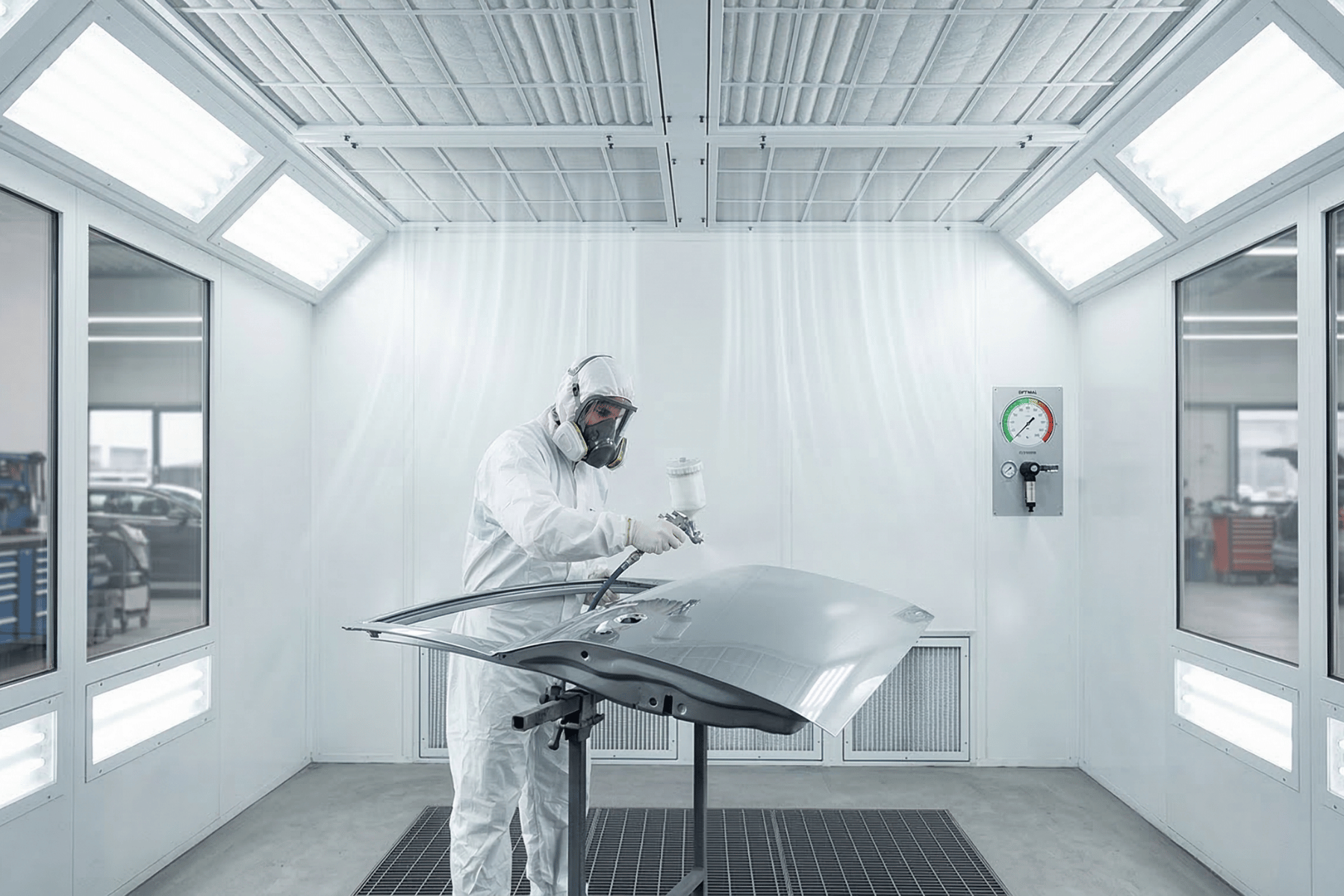
Why Spray Booth Filters Are the Engine of Your Operation
You’ve got a car in the booth. The prep was flawless. The base coat went down smooth. Then, right as you’re laying down the clear coat, a speck of dust drops from the ceiling filter.
It hurts.
Now somebody has to spend the next three hours flat-rubbing and polishing out nibs that never should have been there in the first place. You’re paying for the extra labour, your throughput grinds to a halt, and the customer is wondering why their car isn’t ready.
Think of your spray booth like a high-performance V8 engine. You wouldn’t run a blown V8 with a blocked air intake, right? It would choke. The same logic applies here. Saturated, degraded, or poorly fitted filters strangle your booth.
The blunt truth is this: every clogged filter steals airflow.
As the spray booth filtration specialists, AeroFlow sees this every day across Australian workshops. We’re in the business of keeping your operation running without the headache of rework. Here is exactly why your filters are the real engine of your paint shop—and how getting them right changes the math on your daily output.
The Mechanics: How Filtration Drives Airflow and Quality
Filtration isn’t just about catching floating paint. It’s entirely about airflow management.
Air enters your booth through the intake or ceiling filters. It’s drawn down over the vehicle—picking up overspray along the way—and pulled out through the floor or exhaust filters. For a flawless finish, that air needs to travel in a perfectly straight line downwards. We call this laminar airflow.
When your filters are functioning correctly, air travels at an optimal velocity (usually around 0.4 to 0.5 metres per second). But when a filter fills up with particulate, you get a pressure drop.
This isn’t just theory. If your exhaust filter is rated to trap 15-micron particles and it reaches capacity, the air literally has nowhere to go. It backs up. That laminar flow turns into a turbulent vortex, bouncing overspray off the walls and straight back onto your wet paint.
You need filters engineered with specific densities to trap heavy overspray while maintaining that critical velocity.
(And honestly, if you’ve ever seen a bloke trying to patch a gap in a ceiling filter frame with masking tape because the imported filter he bought was 10mm too short—you know exactly why precise dimensions matter. Tape doesn’t hold back 10-micron dust).
Symptoms of a Failing Engine: When to Change Your Filters
Most operators push their filters too far to save a buck. But how do you know when your “engine” is failing? Look for these three symptoms.
1. Dust and Nibs in the Finish
This is the most obvious red flag. If your painters are spending an hour buffing out dirt inclusions on every bumper they spray, your ceiling filters are either saturated or they aren’t sealing properly in the frames. The direct cost of this rework—wasted man-hours and delayed handovers—massively outweighs the cost of replacing the filter.
2. A Drop in Booth Pressure
When exhaust filters clog, they restrict the air leaving the booth. This causes a positive pressure build-up. Suddenly, instead of overspray being pulled neatly into the floor pits, it lingers in the air. The booth stays cloudy. That suspended overspray eventually lands exactly where you don’t want it.
3. Increased Curing Times
Slower airflow equals slower drying. If your booth takes 20% longer to bake a car, you’re losing a whole job off your daily schedule. If you want to reduce spray booth downtime, you need air moving freely through the system.
Tackling the Tough Questions: Cost, Fit, and Replacements
We hear the same questions every week from workshop managers and procurement officers. Let’s address them directly.
“Is this as good as the original manufacturer part?” Yes, and often better. If you’re looking for an OEM filter replacement, AeroFlow manufactures filters that meet or exceed original factory specifications. We benchmark our industrial-grade filters against major global players like Camfil. You get the exact same holding capacity and structural integrity, without the imported price tag.
“Will it fit my specific, older machine?” Age and brand don’t matter. Every booth is slightly different, and frames warp over time. That’s why we supply custom-sized filters. A filter is useless if air can bypass the edges. We cut to your exact dimensions so the filter drops in and seals perfectly. No gaps. No tape. No bypassed air.
“Is it worth the cost compared to budget imports?” Look, the math is simple. You might save $50 upfront buying a cut-rate imported roll. But what happens when the media collapses under pressure? One ruined paint job on a late-model European car will cost you exponentially more in rework, materials, and lost time. You aren’t buying a filter. You’re buying insurance against rework.
Beyond Panel Beaters: Heavy Industry Demands
While auto body shops are the traditional home of the spray booth, high-level filtration goes much further. The demands are just as brutal across other Australian sectors.
- Industrial Coatings & OEM: For large-scale manufacturing runs—whether painting structural steel or custom cabinetry—consistency is everything. Procurement teams rely on us because a halted production line costs thousands of dollars an hour. We also work directly with spray booth installers who need reliable, local supply for turnkey projects.
- Mining & Marine: Heavy industrial setups deal with massive volumes of rugged particulate. Marine epoxies and industrial enamels will destroy lightweight filters in hours. You need heavy-duty fibreglass and high-capacity pleated media to handle the load.
- Hospitals & Healthcare: Facilities managers operate in a completely different risk bracket. Airborne infection control requires absolute precision. Proper HVAC and exhaust filtration is mandatory for creating safer, cleaner environments. There is zero margin for error when mitigating airborne pathogens.
Compliance and Safety: Meeting Australian Standards
You can’t talk about spray booths without talking about the law.
Paints contain fumes, volatile organic compounds (VOCs), and heavily regulated chemicals like isocyanates. These are serious respiratory hazards. If you exhaust these chemicals straight into the local neighborhood, you are going to get a knock on the door from the EPA or your local council.
Proper Australian compliance filtration isn’t just about paint quality. It’s about occupational health and safety. AeroFlow filters are engineered to capture the specific particulate sizes mandated by Australian environmental standards. We keep your staff safe from respiratory hazards, and we keep the council off your back.
Case Study: Eliminating Rework for Bayside Auto Body
Let’s look at how this plays out in the real world.
A mid-sized panel shop down the coast with 20 staff was pulling their hair out. They were hitting a 15% rework rate. Every sixth car had to be flat-rubbed due to heavy dust inclusion. They thought their booth was broken.
We took a look. The problem was their filters. They were using poorly fitted, imported ceiling filters that were too coarse for fine automotive clear coats.
The Solution: We stripped out the degraded media and installed AeroFlow custom-sized filters rated to the correct micron level.
The Result: They improved their finish quality by 95%. Curing times dropped back to factory spec because the booth could finally breathe, and they virtually eliminated polishing rework. The painters went back to actually painting.
Want the exact specs we used for Bayside? [Download our Technical Data Sheet (PDF) here to see the micron ratings and airflow holding capacities.]
Keep Your Operation Running Smoothly
Your spray booth is only as good as the filters inside it. It’s that simple.
Don’t let a saturated, poorly fitting filter bottleneck your revenue and force your team into hours of unpaid rework. Get the right filter, cut to the right size, and keep your airflow moving.
Need a filter fast? We’ve got you covered. Contact the spray booth filtration specialists today for custom-sized filters, fast, local supply, and a product built to keep your operation running.