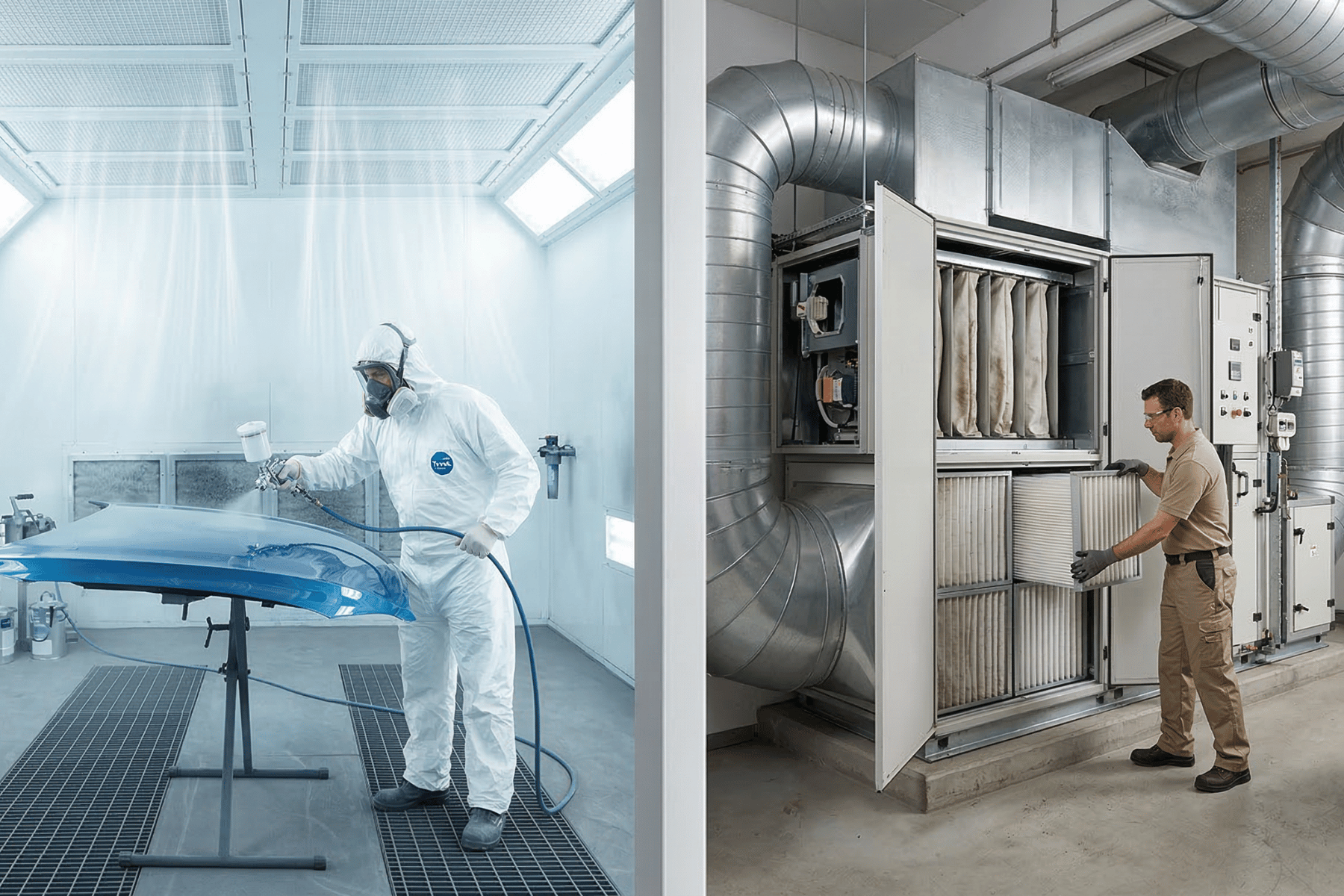
Spray Booth Vs. General Ventilation: Understanding Filter Basics To Protect Your Profits
You’ve prepped the panel, laid down the base coat, and hit it with the clear. Everything looks flawless in the booth. Then you check back twenty minutes later and see it. Dust nibs.
It’s the daily grind for panel beaters and industrial coating facilities everywhere. Time is money. Rework destroys margins. And more often than not, the culprit isn’t your gun setup or your paint mix. It’s your airflow.
Every clogged filter in your system actively steals airflow. When the pressure drops, overspray stops exhausting properly and instead hangs in the cabin, eventually settling right back down on your wet paint and ruining the finish. It’s a frustrating, expensive problem.
But it’s also highly preventable. Understanding the basics of your spray booth and ventilation filters is the fastest, most reliable way to protect your profit margins.
Let’s look at exactly what is happening inside your extraction system, and how the right filter media keeps the air moving and your business profitable.
Decoding Filter Specs: Microns, Airflow, and OEM Equivalents
The filtration industry loves throwing technical specifications around. Arrestance. Pressure drop. Velocity. Honestly, if you are running a busy workshop, you just want to know that the filter will catch the dust and let the air out.
But understanding a couple of core metrics—specifically your micron rating—is critical for achieving a flawless paint finish.
Why Microns Matter
A micron is one-millionth of a meter. For context, a human hair is roughly 70 microns thick. When we talk about a filter’s micron rating, we are talking about the size of the particle it can reliably capture. If your intake filters have the wrong rating, microscopic dust bypasses the media, enters the cabin, and lands in your clear coat.
If your exhaust filters lack the proper holding capacity, they block up. This causes the extraction fans to work overtime against the restricted airflow, leading to pressure imbalances in the booth.
The Problem With Low-Cost Imports
Here is where it gets interesting. A lot of procurement teams look at the upfront cost of budget imported filters and think they are saving the business money. They aren’t.
Budget imports usually suffer from a localized issue called “blinding”. This means the filter media only catches particles on its very surface, rather than drawing them deep into the fibers (depth loading). Once that surface layer blinds over, the filter is effectively a brick wall. The airflow plummets, overspray hangs in the air, and your energy bills spike because the exhaust fan is fighting a massive pressure drop. You end up throwing the filter away weeks before you should have to.
OEM Equivalency and Performance
You might be wondering if aftermarket filters can match the original manufacturer parts installed in high-end European spray booths. The short answer is yes—provided you source them correctly.
AeroFlow filters are engineered to meet or exceed original equipment manufacturer specifications, directly benchmarking against tier-1 brands like Camfil. We use progressive density media that captures heavier particles at the front and finer particles at the back. This maximizes airflow and extends the operational life of the filter.
For the procurement managers reading this who need the hard data to sign off on a purchase order: we back our media with highly detailed, downloadable PDF data sheets detailing exact arrestance rates, initial resistance, and holding capacities.
Will It Fit? The Importance of Custom-Sized Filters
Not every spray booth rolls off an assembly line with identical, off-the-shelf dimensions. If you are operating an older downdraft booth, a modified crossdraft setup, or a heavy-duty marine coating facility, standard filter rolls rarely fit perfectly out of the box.
And fitment is everything.
Air is lazy. It will always take the path of least resistance. If you have even a 5mm gap between the edge of your filter media and the holding frame, contaminated air will bypass the filter entirely.
That bypass air carries wet overspray straight into your ducting and exhaust fans. Over time, that paint builds up on the fan blades, throwing them off balance and eventually burning out the exhaust motor. What should have been a standard consumable swap turns into a massive mechanical repair bill.
You can’t afford to jam a close-enough filter into your frames and hope for the best. This is exactly why AeroFlow cuts custom-sized filters to your exact dimensions. A precision cut ensures a tight, edge-to-edge seal inside the frame, completely eliminating bypass air. Your paint finishes stay clean, and your exhaust fans stay balanced.
Compliance and Safety: Meeting Australian Standards
Filtration isn’t just about making cars look good. If you operate an industrial coatings facility, a hospital, or manage commercial spray booth installations, you are dealing directly with risk, liability, and strict local regulations.
Exhausting Clean Air
In Australia, the design, construction, and testing of spray painting booths are governed by AS/NZS 4114. The environmental authorities in your state are remarkably strict about what you are allowed to exhaust into the atmosphere.
If your ventilation filters fail, you aren’t just dealing with paint defects; you are blowing volatile organic compounds (VOCs) and isocyanate-laden overspray into the neighborhood. The fines for environmental breaches are severe, and they can shut a facility down overnight. Using correct, high-arrestance media ensures your exhaust stacks remain compliant.
Mitigating Industrial and Healthcare Risks
This compliance extends far beyond the automotive sector. Facilities managers in healthcare and heavy industrial manufacturing know that maintaining steady, balanced airflow is critical to building safer, cleaner environments for staff.
In a heavy coating environment, uncaptured overspray settling on floors and ducting creates an extreme fire hazard. Paint dust is highly combustible. Proper filtration mitigates this buildup. In cleanroom or hospital environments, the stakes shift to respiratory safety and infection control. The underlying physics remain the same: reliable extraction systems require precise, uncompromised filter media to do their jobs.
Case Study: Slashing Downtime and Rework Costs
Theory and compliance are great, but what does this actually look like on the workshop floor?
Consider a mid-sized commercial panel shop we recently partnered with. They employ twelve staff, push a high volume of fleet vehicles through two downdraft booths, and operate on razor-thin turnaround times.
The Problem: They were suffering from a 15% rework rate due to heavy dust inclusions in their clear coats. Their painters were spending hours every week color-sanding and buffing out nibs. The bottleneck was costing them thousands in lost labor and delayed deliveries.
The Audit: An onsite assessment by our team revealed two main issues. First, they were using a low-grade, rigid filter that was blinding over after just two weeks of use. Second, the filters were slightly undersized for the frames, creating a bypass channel that sucked shop dust directly into the cabin.
The Solution: We removed the degraded budget filters and replaced the entire bank with AeroFlow’s exact-fit, progressive-density ceiling media and high-capacity fiberglass floor arrestors.
The Result: By eliminating the bypass gaps and stabilizing the cabin pressure, the shop improved its first-off-the-gun finish quality by 22%. Furthermore, because the new media utilized depth-loading rather than surface loading, we extended their routine maintenance cycle by a full three weeks. This direct intervention helped significantly reduce downtime and completely eliminated their weekly sanding bottleneck.
(See the mechanical graph below for a visual breakdown of their stabilized pressure drop over a six-week period compared to their previous setup).
Partner with the Filtration Specialists
High-quality filtration is not a consumable expense to be minimized. It is a direct insurance policy for your paint jobs, your exhaust machinery, and your business’s profit margins.
Every minute your booth sits idle while a painter buffs out dirt inclusions is margin you will never get back. You need components that work as hard as your team does, backed by data and built for the realities of commercial industry.
As dedicated spray booth filtration specialists, AeroFlow understands the sheer cost of a downed booth. We don’t just shift units; we consult, audit, and provide exact solutions to airflow problems.
You shouldn’t have to wait weeks for overseas shipping while your paint finishes suffer. Rely on AeroFlow for fast, local supply that keeps your production schedule on track.
Need a filter fast? We’ve got you covered. Request a quote for custom-sized filters today and get back to spraying with absolute confidence.