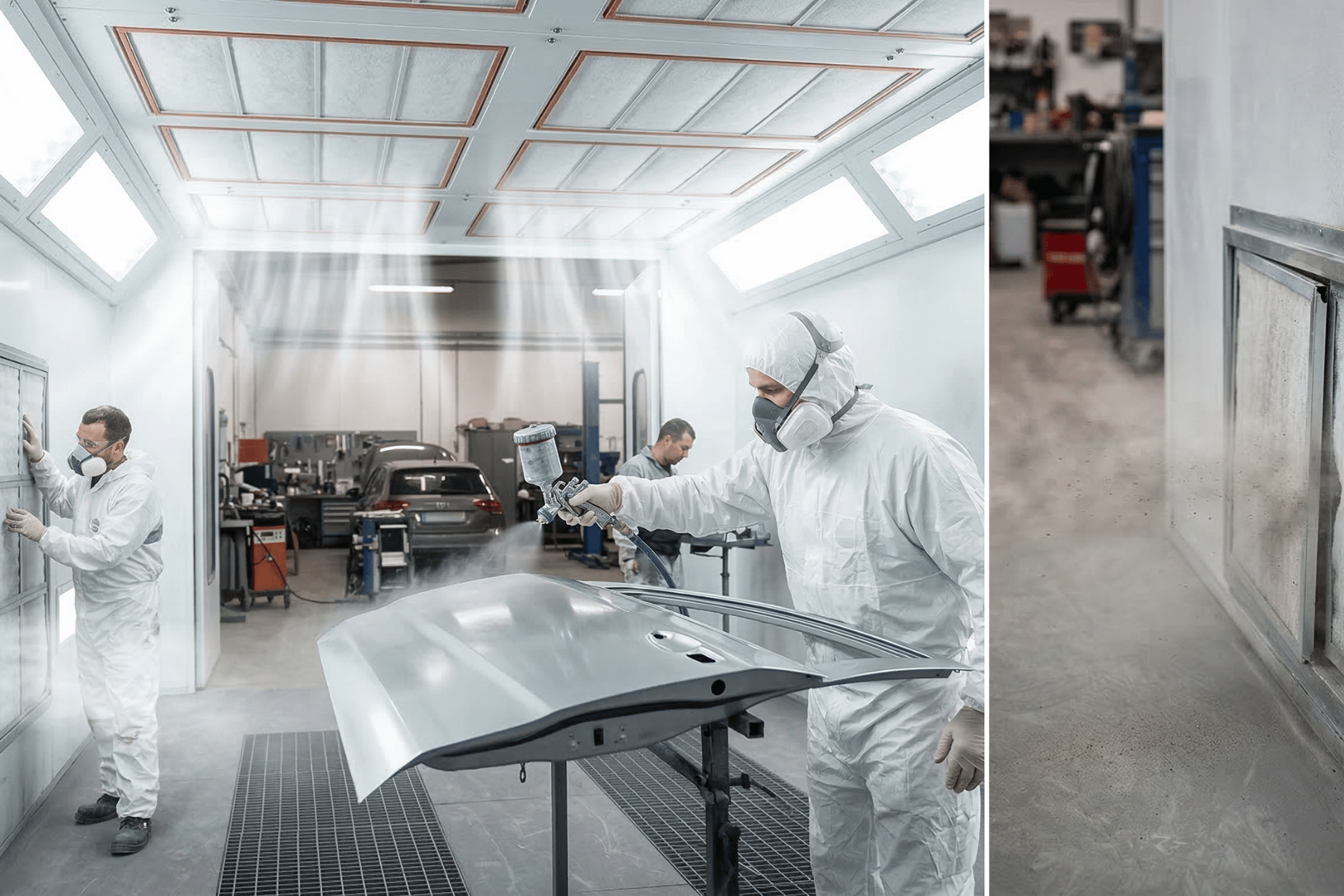
Air Bypass in Spray Booths: Why Air Filters Fail
You just pulled a newly sprayed panel out of the booth. The workshop lights hit the fresh clear coat, and there they are. Dust nibs. Contamination.
Your stomach drops.
That’s hours of sanding, buffing, and repainting you now have to swallow. It destroys your daily margin and pushes every other job in the shop back by a day. You blame the prep work. You blame the tack cloths. You might even blame the paint mix.
But the real culprit is usually invisible. It’s air bypass.
You can install brand-new air filters every single week, but if the air isn’t actually going through the media, that filter is nothing more than expensive workshop decoration. Here is exactly what air bypass is, why your current filtration setup might be failing, and how to eliminate the problem for good.
What is Air Bypass?
Physics is brutally simple. Air is lazy. It will always take the path of least resistance.
In a perfectly functioning spray booth, the extraction fan pulls contaminated air directly through the dense fibers of your exhaust filters, trapping overspray and particulates. But if there is even a millimeter of space between the filter frame and the metal housing, the air won’t push through the resistance of the filter media. It will rip right through that gap instead.
That is air bypass.
The result? Unfiltered particles—often smaller than 10 microns—dump straight into your spray zone, ruining the finish.
But it doesn’t stop there. Bypass compromises the entire exhaust system. Unfiltered 2-pack overspray coats your fan blades, altering their pitch and destroying their balance. Eventually, that overspray is pushed out into the atmosphere. If that exhaust lands on cars parked next door, or if the local council gets a whiff of VOCs escaping your stack, your compliance with Australian environmental standards is instantly compromised.
4 Reasons Air Filters Fail and Cause Bypass
When a shop manager calls us complaining about dust inclusions, they almost always say the same thing: “But the filters are new!”
Age isn’t the only factor. As spray booth filtration specialists, we see the same four mechanical failures causing bypass across the industry.
1. Incorrect Sizing (“Will it fit my old machine?”)
Standard off-the-shelf filters are built for standard, brand-new booths. But what if your booth is fifteen years old? What if it’s a retrofitted shipping container or an older industrial setup?
People try to force a 500x500mm filter into a 510x510mm hole. That 10mm gap is a superhighway for dust.
“Close enough” does not exist in aerodynamics. If the frame doesn’t sit flush against the track, bypass is guaranteed. This is exactly why custom-sized filters are a non-negotiable requirement for older or heavily modified spray booths. You need exact dimensions, not approximations.
2. Structural Collapse from Flimsy Imports
Let’s talk about those heavily discounted filters flooding the market. They usually feature flimsy, single-wall cardboard frames and low-density spun glass media.
When you turn on a heavy-duty extraction fan, the negative pressure is immense. Those cheap cardboard frames simply buckle under the strain. They bow in the middle, pulling the corners away from the housing. The moment that frame warps, the seal is broken. You saved forty dollars on the purchase price, but you just bought yourself four hours of rework.
3. Damaged Filter Housings & Seals
Panel shops and industrial manufacturing facilities are rough, high-intensity environments. Over years of use, the metal tracks holding your filter banks take a beating.
Heavy-handed installations, accidental knocks with parts carts, and thousands of hours of vibration can warp the metal housing. Even if your filter is perfectly rigid, a warped track means it won’t seal perfectly. You need a filter frame thick enough, and gasket material compressible enough, to bridge those imperfections.
4. Pushing Filters Past Their Lifespan
Here is a hard rule of filtration: Every clogged filter steals airflow.
When a filter becomes overloaded with dried paint and workshop dust, the air can’t get through. But the fan keeps pulling. This causes a massive spike in static pressure. The air becomes trapped, building up force until it literally blows out the sides of the filter, breaking the seal and forcing its way around the edges.
You aren’t saving money by stretching your filter changeout schedule an extra two weeks. You are just forcing the air to bypass the system entirely.
The True Cost of Air Bypass
Air bypass doesn’t just annoy the painter. It directly impacts the operational profitability of the entire facility.
- Automotive Spray Booth Operators: It’s all about bottlenecks. Sanding back and repainting a panel destroys your daily output. You cannot bill for rework. You just lose the time, the labor, and the paint.
- Industrial Coatings & OEM: In large-scale manufacturing, bypass leads to massive batch failures. If you are coating heavy machinery or architectural steel, a contaminated finish means procurement headaches, rejected deliveries, and damaged client trust.
- Healthcare & Facilities Managers: For hospitals and clean-rooms utilizing similar high-efficiency filtration setups, the stakes are entirely different. Bypass here doesn’t just ruin a surface finish; it compromises infection control. Properly sealed, high-density filtration is the only way to ensure safer, cleaner environments for staff and patients.
OEM vs. Quality Replacements: Are Cheap Filters Worth It?
This is the elephant in the room. When buyers are trying to fix a bypass issue, they usually look at their original manufacturer manual and wonder if they need to pay top dollar for a brand-name OEM replacement—like a Camfil—or if an aftermarket option will do the job.
Honestly, you don’t need to pay inflated OEM brand premiums to get industrial-grade performance.
But you absolutely cannot buy uncertified, paper-thin imports either.
The AeroFlow standard bridges this gap. A reliable replacement filter must meet or exceed the original specifications. That means heavy-duty rigid frame construction that won’t bow under negative pressure. It means high-density media that captures particles down to the required micron level.
Value doesn’t come from a cheap sticker price. Value comes from precise fitment and structural integrity that holds a seal from day one until the day it’s replaced.
Case Study: Eradicating Rework in a High-Volume Panel Shop
A mid-sized automotive panel shop in Victoria (running 20 staff across two shifts) contacted us recently. They were bleeding cash. They had a 15% rework rate due to heavy dust inclusions in their clear coats.
The frustrating part? They were changing their cheap imported filters every single Friday.
We audited the booth and immediately found the issue. The filters they were buying had thin, recycled-cardboard frames. By Tuesday of each week, the extraction fan pressure was causing the frames to warp inward, creating a 5mm gap along the top edge. For the rest of the week, unfiltered shop air was dumping straight onto wet paint.
We mapped the precise internal housing dimensions—which had warped slightly over the booth’s 12-year lifespan—and supplied rigid, custom-sized filters designed specifically for their tracks.
The result? Rework dropped to near zero immediately. Furthermore, because the air was now forced through our progressive-density media rather than swirling around the booth, airflow efficiency improved. This meant faster flash-off times, acting to significantly reduce downtime between coats.
How to Prevent Air Bypass in Your Booth Today
You don’t need an engineering degree to fix this. You just need to be meticulous. Here is how you stop bypass before your next job:
- Inspect Seals Weekly: Don’t just look at the front of the filter. Grab a torch and look at the edges of the filter banks. If you see visible dust trails or overspray creeping around the sides of the frame, you have a bypass leak.
- Measure Accurately: Don’t guess your dimensions based on the old, crumpled filter you just pulled out. Measure the actual internal metal housing track.
- Monitor Static Pressure: Stop guessing when your filters are full. Install a simple manometer on your booth. It measures the pressure drop across the filter bank, telling you exactly when the media is fully loaded so you can change it before bypass occurs.
- Source Locally: When your booth is down, or you realize your current filters are buckling, you can’t wait four weeks for an overseas container to clear customs. You need fast, local supply from an Australian manufacturer who understands local compliance laws.
Secure Your Finish with AeroFlow
Air bypass is a highly destructive, yet entirely preventable problem. A flawless paint finish, a highly efficient workshop, and strict Australian regulatory compliance all start with two things: an airtight seal and a structurally sound filter.
Don’t let a 5mm gap dictate your rework schedule.
Whether you need standard sizes for a brand-new setup, or highly specific custom-sized filters for an aging machine, AeroFlow delivers. We build filters that fit exactly, hold their shape under immense pressure, and capture the microns that ruin your margins.
Get the exact specifications you need with fast, local supply.
Contact our technical team today to reduce your downtime or to find the perfect fit for your specific booth.