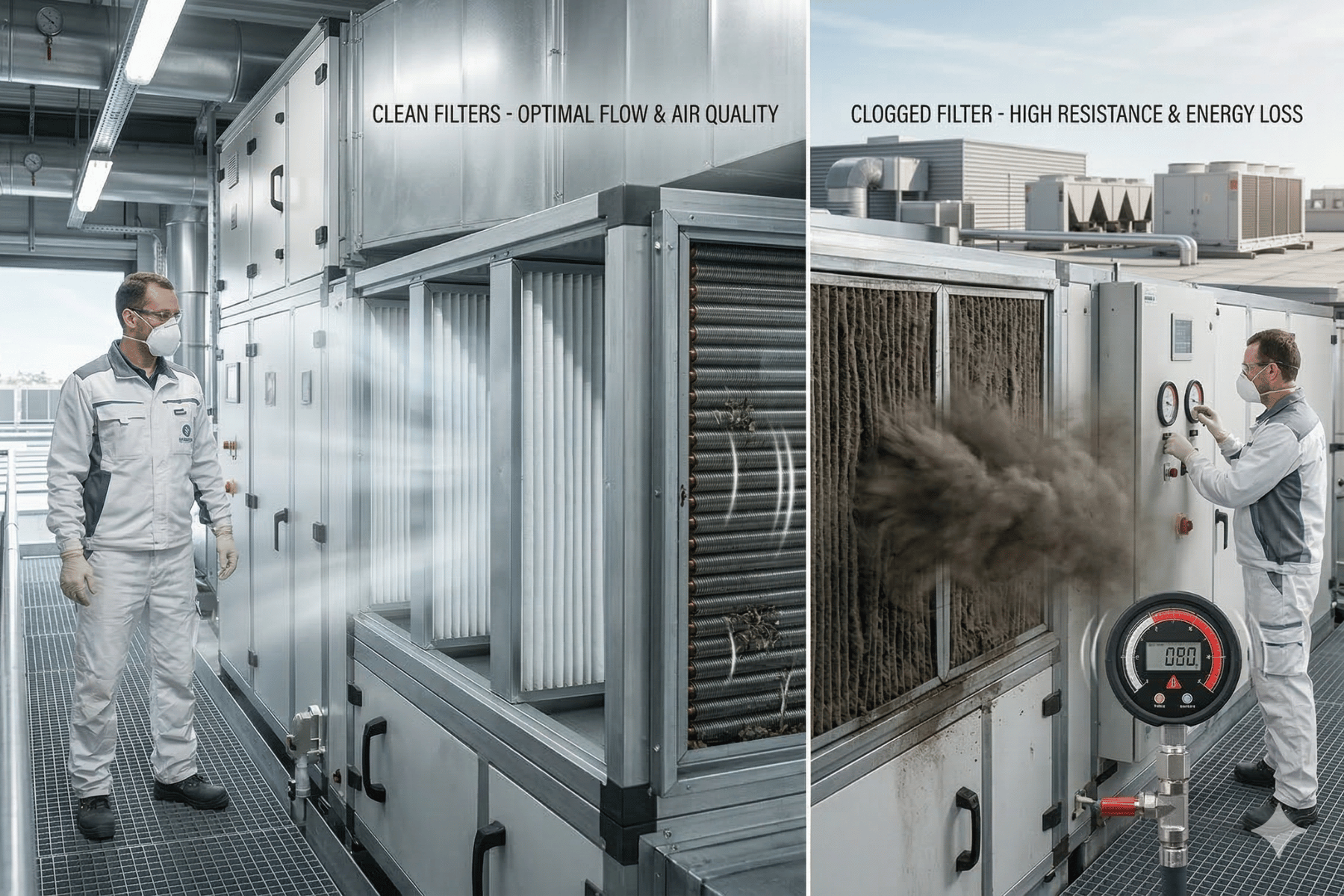
Every clogged filter steals airflow.
It is a fundamental truth of industrial ventilation that usually gets ignored right up until the electricity bill arrives. Or worse, until an entire batch of panels needs a complete respray because the extraction failed and overspray settled right back onto the wet clear coat.
Clogged industrial and HVAC filters do significantly more than just choke your extraction systems. They cause massive spikes in operational costs, push heavy-duty fan motors to the absolute brink of failure, and quietly drain your profit margins. Ignoring a filter replacement schedule doesn’t save money. It just defers a much larger, much more painful invoice.
To definitively reduce downtime and protect your machinery, you need to understand exactly what happens when your air extraction hits a brick wall. And more importantly, you need a reliable partner to solve the bottleneck. That’s where AeroFlow comes in.
The Physics of Clogged Filters: Why Airflow Costs Money
Let’s look at the mechanics of what is actually happening inside your exhaust wall.
As your spray booth exhaust filters or commercial HVAC filters capture particulate matter—measured in tiny increments called microns—the synthetic or fiberglass media becomes dense. The tiny pathways designed to let clean air escape start to shut down. This creates a phenomenon engineers call “pressure drop.”
Your exhaust and intake fans don’t just magically stop working when a filter gets blocked. They pull harder. They fight the restriction.
A clogged filter forces the fan motor to draw significantly more amperage to move the exact same volume of air. The motor works twice as hard, pulling double the electricity, just to maintain the minimum airflow required to keep your booth operational. You aren’t paying for better extraction at that point. You are literally paying for friction.
It’s a compounding problem. The more loaded the filter gets, the higher the pressure drop. The higher the pressure drop, the faster the electricity meter spins. Swapping out a saturated filter for a clean one instantly drops the resistance, allowing the fan to return to its baseline power consumption.
Extending Equipment Life & Preventing Costly Breakdowns
Spiking energy bills are only the immediate symptom. The long-term disease is mechanical failure.
When extractors have to pull against a heavily blocked intake, the entire mechanical system suffers. Belts stretch and start to slip on their pulleys. Bearings overheat under the added resistance. Three-phase motors run at maximum load for hours on end, building up excessive heat.
Eventually, the motor simply gives up.
Replacing a burnt-out extraction fan on a commercial setup costs thousands of dollars in parts and labor alone. And that doesn’t even factor in the days your facility sits completely idle waiting for an emergency repair. Proactive, scheduled filter replacements are the absolute easiest way to reduce downtime.
It’s basic business maths. You can spend a fraction of your operational budget on fresh industrial air filtration, or you can blow your capital expenditure replacing ruined machinery. You can’t avoid paying for maintenance; you only get to choose how you pay for it.
Industry Impacts: More Than Just Energy Savings
While the physics of airflow remain the same, the financial fallout of poor filtration looks different depending on your specific sector. The right filter does more than protect a motor—it protects your core business output.
Automotive Spray Booths & Panel Beaters
For the automotive repair sector, everything comes down to the quality of the finish.
When your exhaust filters are choked, the booth loses its negative pressure. The extraction slows down, meaning atomised paint and overspray don’t get pulled away from the vehicle. Instead, they bounce off the walls and land squarely back on the fresh paint job.
Think about the hidden costs of rework. You have to factor in the wasted labour hours spent sanding back the ruined finish, the cost of the wasted materials, and the bottleneck it creates for the next vehicle waiting to get into the booth. A single ruined paint job costs significantly more than a box of clean filters. As spray booth filtration specialists, we see this exact scenario play out weekly. Upgrading your maintenance schedule solves it instantly.
Healthcare Facilities & Hospital Managers
In the medical sector, filtration isn’t about paint; it’s about strict infection control.
Facility managers are constantly balancing heavy compliance demands. Hospitals rely on consistent, reliable airflow to maintain positive and negative room pressures in isolation wards and operating theatres. If a commercial HVAC filter degrades or clogs, that pressure differential fails.
Maintaining safer, cleaner environments is a non-negotiable requirement under Australian health and safety standards. High-efficiency filtration ensures that airborne pathogens and hazardous particulates are trapped effectively, protecting both staff and vulnerable patients.
Industrial Coatings, Mining & Marine
Heavy industry operates on a massive scale where downtime is measured in the tens of thousands of dollars per hour.
Large-scale OEM manufacturing and industrial coating lines rely on absolute consistency. If a marine coating facility loses extraction because of sub-standard filters, the entire production line grinds to a halt. Heavy-duty reliability isn’t a luxury here—it’s a basic requirement. These facilities need heavy media that can handle high volumes of coarse particulates without collapsing under industrial fan pressure.
Overcoming the Objections: Getting the Right Fit & Value
We hear the same concerns from procurement officers and workshop managers every day. When it comes time to order replacements, you need to know exactly what you are paying for. Let’s address the realities of upgrading your filtration head-on.
“Is this as good as the original manufacturer part?” Yes. In fact, AeroFlow filters are rigorously benchmarked against industry giants like Camfil. We engineer our media to meet or exceed the required technical specifications and stringent Australian standards. You get the exact same (or better) micron-capture efficiency and structural integrity, without paying the inflated premium associated with a proprietary brand label.
“Will it fit my specific or older machine?” Older booths and legacy extraction systems rarely conform to modern standard sizes. Modifying your exhaust wall to fit an off-the-shelf filter is a massive headache. That’s why we provide custom-sized filters. Installers and operators can get the exact dimensions they need, ensuring a perfect seal and zero air bypass, with no retrofitting required.
“Is it worth the cost compared to budget imports?” Look, you get what you pay for in this industry. Inferior, budget-grade materials degrade rapidly under pressure. They suffer from media migration—meaning the filter actually starts breaking apart and blowing fibers downstream. Worse, they allow larger microns to pass right through, leading directly to the rework and motor damage we discussed earlier. Buying a subpar filter means you’ll just end up buying a replacement fan motor down the track.
Case Study: Improving Finish Quality and Slashing Downtime
Let’s look at the actual data.
A mid-sized commercial panel beater in Victoria was battling persistent contamination issues on their final clear coats. Their extraction fan was drawing heavy amperage, and the workshop was losing roughly five hours a week to sanding out overspray nibs. They assumed the extraction fan was failing.
We reviewed their setup and their Technical Data Sheets. The issue wasn’t the fan; it was the dense, incorrect filter media they had bulk-bought from an overseas supplier months prior. It was totally unsuited for the volume of paint they were spraying.
We swapped them to a correctly rated AeroFlow exhaust media and established a strict, rotational replacement schedule.
The results were immediate:
- A 15% measurable reduction in paint rework.
- A 22% drop in the fan motor’s electrical load.
- Complete elimination of overspray bounce-back.
By matching the exact right micron rating to their specific application, the facility regained its extraction power and instantly improved its output quality.
Fast, Local Supply When You Need It Most
Clean filters equal lower electricity bills, longer-lasting equipment, and a vastly superior quality of work. It really is that straightforward.
But knowing you need a filter and actually getting one in your hands are two different things. When a spray booth goes down or compliance is breached, you cannot afford to wait three weeks for overseas shipping to clear customs. You need a partner who holds stock on the ground.
That’s why AeroFlow is built around fast, local supply. We understand Australian conditions, we know the local regulations, and we have the inventory ready to dispatch.
Don’t let a choked intake dictate your production schedule or ruin your machinery. Check your specific machine dimensions, review the technical specs, and browse our locally stocked, custom-sized filters today. Ensure your facility stays compliant, operational, and profitable.